

Bigger Than the Superman Building: RI Business Subsides Top $139M
The state issued about $139.2 million in various subsidies to local businesses in fiscal year 2025, according to an Ocean State Current review of the RI Commerce Corporation’s annual report for that year.
In late August, RI Commerce made headlines after it authorized another $9.5 million in public funds to assist the developer.
The funding was awarded just three years after Gov. Dan McKee had pledged that no new taxpayer money would be invested in addition to the $90 million it had already committed to the project. As a recent GoLocalProv editorial noted, “Each time, they ask for more and more. A deal is never a deal. No agreement is ever an agreement.”
But the Superman Building is just the tip of the iceberg when it comes to taxpayer funds that go to local businesses.
In 2025, the RI Commerce Corporation dispensed a wide range of subsidies to local businesses in the form of loans, grants, tax credits, tax breaks, and other financing. The estimated total of $139.2 million estimate includes funds given to third parties that then, in turn, provided assistance to local businesses.
About half of the new funding for the Superman project came out of the Rebuild Rhode Island Tax Credit Program, which totaled $19.1 million in awards in 2025.
In the decade since it was established, in 2015, local businesses received $218.5 million in awards through the Rebuild RI program.
RI Commerce also approved $17 million in Qualified Jobs Incentive Tax Credits in 2025, at a rate of up to $7,500 per job per year.
Gov. Dan McKee says these programs advance bipartisan goals such as job creation, support for small businesses, stimulating the economy, and increased affordability. As McKee noted in a letter included in the annual report, “We are creating jobs, attracting new companies and helping local businesses grow.”
But critics view such programs as just another form of corporate welfare, albeit for smaller, local businesses.
“They are not worth it. They are economic development programs that fail to develop the economy,” said James Hohman, Director of Fiscal Policy at the Mackinac Center for Public Policy in Michigan.
“Economists have used sophisticated methods to assess costs and benefits of selective favors and sometimes they find positive effects, but most of the time they find negative effects,” Hohman added. “They never find large effects. That is, lawmakers say that their efforts to lure the next big thing secure the state’s economic future. Their policies are unable to deliver on this expectation.”
For example, a 2020 paper in the Journal of Economic Perspectives analyzed businesses assistance and incentive programs across the country and concluded: “While the authors find some evidence of direct employment gains from attracting a firm via incentives, they do not find strong evidence that firm-specific tax incentives increase broader economic growth at the state and local level.”
In terms of job creation, Hohman said the results are especially disappointing. “The selective subsidy deals rarely bring the jobs that lawmakers say they will when they announce their deals. I looked at the major deals in Michigan from 2000 to 2020 and found that companies created just 9% of the jobs that were announced,” he told the Current.
A spokeswoman for RI Commerce did not respond to a request for comment.
For the Rebuild RI tax credit programs, the state does publish impact reports showing the outcomes of the awards. For example, in 2021, RI Commerce gave $441,000 worth of credits to Miniature Casting, a Cranston-based company that manufactures zinc die cast used in several industries. The tax credits helped fund an expansion, along with a promise of 12 new jobs. An impact analysis produced two years later shows there were 12 jobs generated, but just 8 of them were directly attributable to funding from the state.
An even bigger issue is one of fairness. According to critics like Hohman, when the state subsidized specific businesses, it puts itself in the position of picking winners and losers, rather than creating a fair and even playing field for all.
The 2020 Journal of Economic Perspectives paper found that $30 billion in annual spending on business tax incentives by state and local governments was “channeled to a very small collection of firms opening offices in new locations”—less than .01% of such businesses.
“There is a more basic reason why policymakers ought to say no to selective favors. It ought to offend our basic principles about government. We’re all supposed to be equal under the law, and it ought not be our lawmakers’ job to take money from some people to give to select others in the name of economic development,” Hohman said.
“This isn’t just a statement of principle, it is enacted law,” Hohman added. “The corrupt favoritism from the early American states left many of them insolvent. And it led people to add prohibitions to their state constitutions against using the public purse to advance other people’s private interests that remain core constitutional language.”
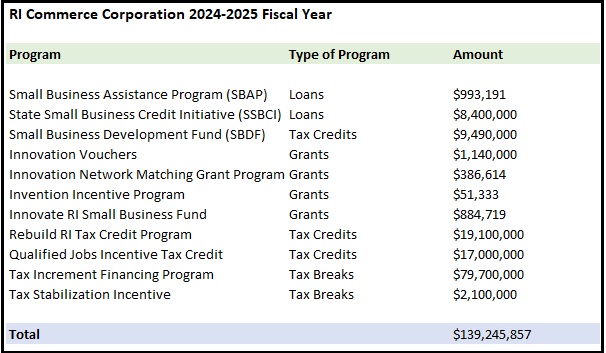
Photo credit: Wikipedia/Rhododendrites


.jpg)