Nearly 1 in 5 RI Public School Students Are Chronically Absent
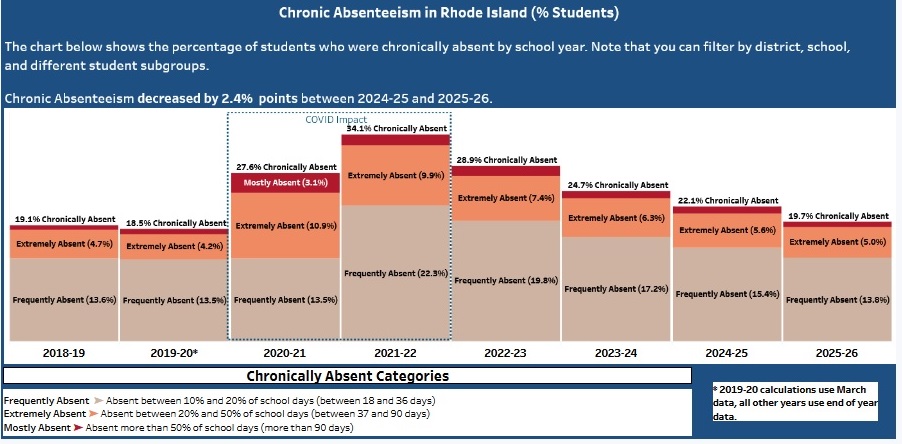
The rate of chronic absenteeism in Rhode Island public school has declined to 19.7%, down from pandemic highs of about half all students in some places, according to a state press release issued weeks before the start of the new school year.
In Providence, 25.3% of students were chronically absent during the 2025-2026 school year, 31.8 percentage points lower than the pandemic peak of 57.1% during the 2021-2022 school year.
Likewise, Central Falls saw its rate go from 48.2% to 22.2% during the same period.
Chronic absenteeism is defined as missing more than 10% or more of school days in a year.
While the data shows progress since COVID-19, the flip side is that almost 1 out of every 5 public school students in Rhode Island is skipping 18 or more days of a school a year.
“It’s outrageous,” said Julia Steiny, a prominent local education reform advocate.
Chronic absenteeism has a direct, measurable effect on academic performance. For example, on the 2024 NAEP math test, 45% of students who were in the bottom quartile had missed three or more days of school, compared to just 20% of top scorers who said the same. According to the American Enterprise Institute, 10 days of missed school for elementary and middle school students translated into 6% lower math test scores during the 2022-2023 school year.
Chronic absenteeism is also associated with higher dropout rates, an increase in suspensions, and teen substance use.
The pre-pandemic levels weren’t that much better. For the 2018-2019 year 19.1% students were chronically absent, according to state data. But the pandemic greatly exacerbated the problem. In the 2020-2021 school year, the rate jumped to 27.6%. It climbed even higher the following year, reaching 34.1%.
Statewide the rate is 14.4% less than what it was during the height of the pandemic. The reduction means that an estimated 4.4 million instructional hours have been recovered, according to state officials.
In the press release on chronic absenteeism, Gov. Dan McKee said the state has made “significant gains” in getting students back into classes. Education Commissioner Angélica Infante-Green sounded a similar tone: “Thanks to the tireless work of our students, families, educators, school leaders, and community partners, we have recovered millions of hours of learning and are seeing tremendous momentum across our schools.”
Steiny said state education officials deserve credit for bringing down chronic absenteeism, in an interview with the Current. Still, she said the current rate is not good. She said that state officials should ultimately work towards the goal of getting attendance rates up to 100% of students not being chronically absent.
Both McKee and Infante-Green seemed to acknowledge that the state still has its work cut out for it. McKee noted that “we must continue emphasizing the importance of showing up every day” while Infante-Green said the state would press on with its Attendance Matters initiative “with the goal of improving outcomes for all students.”
Rhode Island is not an outlier when it comes to students absences – the problem is a national one. The most recent estimates on chronic absenteeism put the national average around 20% as well.
Prior to the pandemic, the national rate was 15%.
Steiny said Infante-Green had partnered with AttendanceWorks, a national organization to address the issue. “I give her a lot of kudos because she immediately went up, started partnering with them after COVID,” Steiny said. “They were the ones that said, put up a dashboard, start rewarding high attendance … just make a big deal out of it and that’s how that number came down here.”
For state officials, the first step in tackling the problem is tracking it. The Rhode Island Department of Education has created an online dashboard that tracks attendance rates by schools and provides a statewide ranking. It has also created an “Attendance Calendar Heat Map,” in which number of students present and absent is displayed along with the attendance rate for each day of the school year – with days in which attendance appearing in green, while days with high number of students out of school are red.
In late September, McKee and Infante-Green announced that the state was distributing magnetic calendars to the state’s 140,000 public school students to help them and their parents keep track of school of school attendance.
Beyond that, there is more than can be done. Steiny sees charter schools as one possible solution, since they can be more aggressive in tracking down absentee students without the restrictions imposed by teacher contracts.
But there are steps that other public schools can take as well, such as focusing on improving the school environment, according to Steiny, who points to state’s surveys of students. Those showed that just 58% of elementary students last spring said they felt like they belonged at school. An even lower share, 54%, had a favorable view of the school climate – a metric that incorporates everything from overall mood to how excited teachers appear to be teaching to the cleanliness of the facilities.
Source: Rhode Island Department of Education