State Audit Finds $13.2M in ‘Questioned Costs’
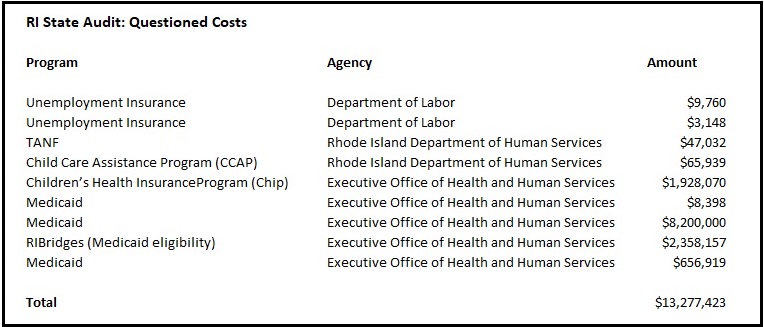
The recent state annual audit uncovered $13.2 million in accidental or improper payments, including many in federally-funded, state-administrated health benefits programs.
In one case, about $2.5 million in Medicaid benefits were paid out to 2,078 individuals who were deceased. In about half of those cases, the accidental payments had continued for over a year. The state also spent $8.2 million more in one Medicaid program than was authorized.
State auditors also found that rehab clinics had submitted “five to seven daily methadone claims for the same beneficiary” to the state, resulting in $875,696 in excess payments.
Under federal auditing standards, ‘questioned costs’ are expenditures that are a violation of a law regulation, or the terms and conditions of a federal funding award; lack necessary documentation; or are unreasonable. Most of the costs questioned in the audit fall into the first two categories, according to state auditor David Bergantino.
“The Single Audit reports these ‘questioned costs’ to the federal grantor agencies who ultimately decide on whether the State will need to repay those funds,’ Bergantino told the Current. “In some circumstances, the federal grantor agency may be satisfied if corrective action is taken moving forward. In some instances, they request repayment of federal funding. Those communications take place directly with the State agency who is the grantee.”
The total amount of costs that are questioned is actually much more than the $13.2 million reported in the audit because state officials were unable to calculate estimates in all the cases.
For example, the state auditor’s staff tested a sample of 60 individuals who received $27,092 from the state unemployment insurance program and found that one of them was not in compliance with the program’s requirement. That resulted in a ‘questioned cost’ of $9,760. But when auditors projected that rate of 1 out of 60 noncompliant individuals to the entire $228 million in benefits in the 2025 fiscal year, the real amount of questioned costs in the program is estimated to be $5.2 million.
“Uniform Guidance only requires reporting of known questioned costs. In many instances, it is the responsibility of the State to review the issue to determine the exact amount of questioned costs and to return those funds to the federal grantor when noncompliance was determined,” Bergantino told the Current.
The audit also revealed that the Department of Labor did not enforce its own rules on properly identifying and handling overpayments, including a mandatory 15% penalty for benefits recipients who committed fraud and reducing charges to their employer’s accounts. Out of a random sample of 40 people received benefits, 9 turned out to be fraudulent. At that rate, the estimated total of improper payments was $509,635 last year.
Out of eight instances of questioned costs where the auditor identified a specific amount, half involved the Executive Office of Health and Human Services, while two others were in the Department of Human Services, which falls under its authority.
“EOHHS takes the findings and recommendations of the Office of the Auditor General seriously, and we appreciate the important role the audit process plays in identifying additional opportunities to strengthen our financial controls and the administration of Rhode Island’s Medicaid program. Medicaid is an extraordinarily large and complex program, and we recognize that there will always be opportunities to strengthen the systems and processes that support its administration,” Kerri White, communication director for the office, told the Current.
“We are committed to addressing the findings identified in the audit and achieving full compliance with applicable state and federal requirements,” White added.
She said that EOHHS has submitted a correction action plan for each finding to the auditor “that identifies specific steps to strengthen controls, improve our processes and address any underlying issue identified in the report.” Some of those steps, according to White, include strong financial reporting, better oversight and internal controls, and, where appropriate, recouping and returning improperly spent funds.
When it comes to the $8.2 million in over-spending and the payments to deceased individuals, she said state officials “are reconciling the amounts, identifying any costs determined to be ineligible, and will make appropriate recoveries or repayments consistent” with federal requirements.
The state auditor’s office does not have any enforcement powers of its own, but Bergantino said it does keep tabs on repeat findings in its annual audits.
“Each Single Audit includes a Summary Schedule of Prior Audit Findings which is completed by the State and reviewed by our office to ensure that the status provided is reasonably accurate based on our continuing audit work or follow-up. Most prior year findings if not fully implemented or resolved, will reference the current year update of the issue reported,” he said.