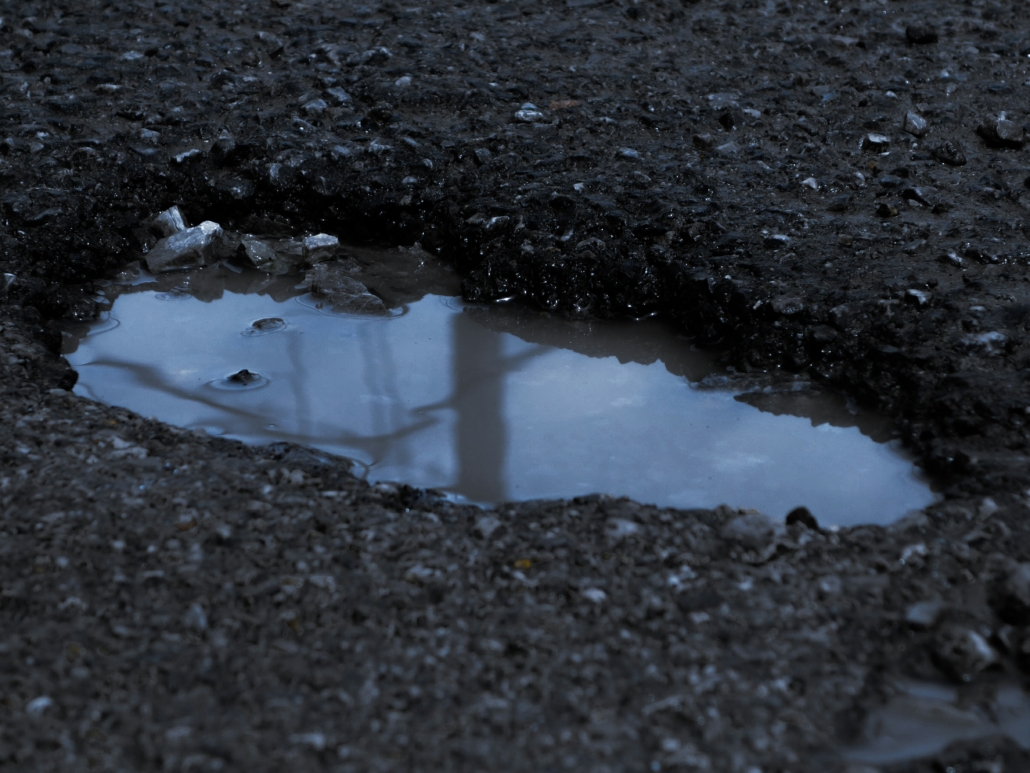
Potholes, Rough Pavement, and Deficient Bridges Drive RI’s Dismal Highway Ranking
Rhode Island’s state highway system is the forty-third worst in the country in terms of spending effectiveness and road condition according to a national ranking produced by the Reason Foundation, a libertarian institute.
In 2023, Rhode Island spent $160,029 in capital and bridge disbursements per lane mile, yet 15.35% of its bridges were structurally deficient and 1.56% of urban interstate highway road mileage were in poor condition, according to the report, which was released earlier this year.
“The state’s very poor ratings in key categories, including 49th out of 50 states in rural arterial road pavement condition, 48th in urban arterial road pavement condition, and 47th in structurally deficient bridges, are what’s driving its poor overall ranking in the Annual Highway Report,” Baruch Feigenbaum, lead author of Reason Foundation’s Annual Highway Report and a transportation policy analyst, told the Current.
“Rhode Island’s bridge conditions are especially problematic as deficient bridges are both a maintenance and a potential safety issue. The state needs to focus resources and energy on reducing the number of deficient bridges, repaving rough roads, and fixing potholes,” he added.
The report comes as the cost for the Washington bridge repair continues to spiral, hitting an estimated $203 million in funds spent so far, four times the original estimate, and years behind the deadline projected at the start of the work.
Annual spending on transportation in Rhode Island currently tops $1 billion, according to the budget approved by the General Assembly in June.
The Reason Foundation report’s overall assessment is comprised of rankings in thirteen individual categories that encompass administrative spending, maintenance costs, urban and rural fatality rates, and congestion.
“The report accurately reflects the observations of Rhode Island drivers very well. Anecdotal assessments do carry weight – and this report seems to back them up. We know we have far too many potholes for example – even compared to NE states,” Rhode Island House Minority Leader Mike Chippendale, R-Foster, told the Current.
Chippendale recalled his own experience driving on I-195 on rainy days, when the surface was “so wet that white-knuckle driving was necessary. Once you saw the ‘Welcome to Massachusetts’ sign, the road surface was much drier, and the type of pavement was clearly different. Water drained better off the Massachusetts portion than the RI portion, and it was always in better condition. This was true on the RI/MA border on 295 as well,” he said.
Rhode Island performed worse than every other New England state, including Connecticut’s (7th), New Hampshire’s (13th), Maine’s (16th), Massachusetts’ (17th), and Vermont (38th). In the Northeast, one other ranked lower: New York, at 47th place.
“Overall, taxpayers and drivers are getting much less value in Rhode Island than in comparable states,” Feigenbaum said. “In the Northeast region, only New York state has a worse-performing, less cost-effective highway system.”
While he agreed with its findings, Chippendale disagreed with some of the methodology.
“The methodology doesn’t necessarily weigh the factors in a manner that would best represent the individual states, but it does arrive at solid conclusions. It uses thirteen metrics which all are given equal weight in the conclusions, and that doesn’t necessarily capture all the nuances,” he told the Current.
For example, Chippendale said comparing “rural interstate pavement condition” and “rural other principal arterial pavement condition” to other states like Tennessee or even other New England states “does not represent a true picture of the same challenges.”
“But it does make one thing very clear – we are that bottom of the New England barrel,” he added.
A spokeswoman for the Rhode Island Department of Transportation did not respond to a request for comment.
In recent years, state leaders have announced a number of steps to address Rhode Island’s beleaguered transportation system. For example, last year Governor Dan McKee announced that a $251.1 million federal grant had been approved for the rehabilitation of 15 bridges in the I-95 and Route 10 corridors between Providence and Warwick.
“We’re committed to strengthening Rhode Island’s infrastructure and maximizing every available federal dollar to get the job done,” McKee said at the time.
And earlier this year, the state launched a 511 hotline for potholes, along with an online dashboard for residents to view the status of pothole repairs.
“We are pleased to provide these tools for the public to make it easier for them to let us know about potholes they see on our roads so we can get them fixed right away,” RIDOT Interim Director Bob Rocchio said in a statement. “In the meantime, all our maintenance districts have been proactively patrolling the roads to identify and fill potholes.”
Between the state of the year and early April, the governor’s office said drivers had reported 630 potholes and that 600 of them had been filled.
The report was not all bad news for the Ocean State. In terms of the rural fatality rate it ranked 4th nationally, and its rural interstate pavement condition was sixth highest.
“We rank very high on safety of our roads, and I think that speaks well of not just the RI State Police and their monitoring of our roadways, but in fairness, much of the rural and urban improvements to our road engineering by RIDOT has been incredibly successful. In my home district, I’ve watched DOT add lane-shifts, traffic signals, and roundabouts with incredible efficacy toward reducing fatalities and motor vehicle crashes. That shouldn’t be overlooked,” Chippendale said.
“Where the assessment hits the hardest and the most accurately is the value-for-money, and maintenance-priorities conclusions,” Chippendale added. “It really should compel a closer examination of where transportation dollars are going, and whether preventive maintenance is occurring soon enough. When we look at how long completed roadwork is lasting, I think it is only logical to conclude that we aren’t getting value for our dollars spent. My constituents will all agree with that conclusion.”