SNAP-to-Jobs Gap Grew in August

Although politicians are looking to the unemployment rate to paint sunny pictures of RI’s economy, in August, the gap between the jobs that the RI economy had created since the recession and the number of Rhode Islanders added to food stamps grew and still led New England.

October 2015 Employment: Still Winning by Losing

Once again, the drop in RI’s unemployment rate is deceptive, resulting from a bigger drop in people actively looking for work than the drop in employment; at least RI had the rest of New England for company in October.

An Unpopular Governor and Phony Employment Gains

A national poll gauging Americans’ approval of their governors finds Rhode Island’s Democrat Governor Gina Raimondo with 46% approval and 39% disapproval.  That puts her at 40th on the list.  (Massachusetts’s Republican Governor Charlie Baker is at the top, with 74% approval and 14% disapproval.)

The response that Raimondo’s spokeswoman, Marie Aberger, provided to Ian Donnis for his Friday column is worth a look, too.  To substantiate the claim that “the numbers make it clear that we’re moving in the right direction,” Aberger mainly cites government initiatives, like additional subsidies for college and an energy tax break for businesses.  Whether good or bad, whether those policies will have positive effects (or sufficient effects to make a difference) remains to be seen.  The only number that could be called evidence of improvement is that “Rhode Island has driven its unemployment rate down 25.3 percent from this time a year ago,” which is a questionable thing to highlight.

I’ll be putting up my monthly employment posts on Monday (here’s the last one), but one quick takeaway is that the amount of employment dropped again, in October, yet the unemployment rate continued to decrease because even more people stopped looking for work.  If I’m correct that we can expect much of the employment gains of the first half of the year to be revised down substantially in January, then employment is not even arguably a strong point for the state, especially considering that job creation in Rhode Island appears to have slowed to a crawl, this year.

That this one (arguably phony) statistic is all that Rhode Island politicians can raise in their defense shows how badly they’ve botched things, around here, and why Raimondo’s approval is where it is.

RI Report Card: Rhode Island Government Still Failing Its People

The RI Center for Freedom & Prosperity’s Competitiveness Report Card for Rhode Island is less of an indication of how Rhode Islanders are doing than what insiders are doing to us.

When the Rhetoric Rolls Over the Facts

Neil Cavuto’s interview with an organizer of the Million Student Whine illustrates that progressives aren’t serious people, even if they are dangerous.

Take This Toll and Shove It

There simply can’t be too many songs lampooning the idea of trucker tolls in Rhode Island, and here’s one to add to my own “Seventeen Tolls.”  It’s “Take This Toll and Shove It” by Billy Mitchell (also singer of the very-Rhode Island “I Know a Guy“).

What’s Recourse for the Phony Quasi- and Non-Publics?

With the Commerce Corporation supervising government agencies and the RI Foundation seeking to claim power outside of government, the question is: When will it be too late to insist on representative democracy?

RI Small Businesses Nation’s Most Pessimistic

Thumbtack is out with its regular survey of small businesses’ feelings about their prospects and the business friendliness of their states, and as one might expect, Rhode Island doesn’t do very well.  It’s one of four states with an F for business friendliness (the others being Connecticut, Illinois, and California), and it’s one of five states in which small business owners don’t have generally positive feelings (the others being Maine, New Hampshire, Iowa, and Kansas).  Of those five, though, Rhode Island businesses’ “sentiment” was last in the nation.

Where Rhode Island businesses think their state is actually business friendly is the “ease of hiring.”  Although that’s an area in which politicians frequently promise assistance — up to and including transforming the state to make Rhode Islanders become the employees that some businesses want — it makes sense that employees would be readily available in a state that continues with minimal job growth.  Notably, the area in which small businesses have the most negative feelings is that of recent hires, suggesting that they don’t feel they’d have much difficulty hiring, but they haven’t had to do so.

The handful of business-owner comments provided on the Web site are telling.  A Wakefield florist chalks the problem up to the fact “the economy here has not recovered as of yet,” but others have more targeted complaints.  A handyman in Greene says that “there are high taxes on everything and you only get breaks if you hire illegal workers.”  A Providence caterer complains that the state doesn’t pay any attention to very small businesses and that the high taxes don’t cover many services that they actually use (other than roads), while the licensing regime is labyrinthine and “each state department thinks that they have to be notified first, so you get sent in circles.”

Perhaps a Cumberland Web designer hits the target closest to its root cause: “Many of our state legislators are long-time union hacks or government-entrenched cronies, so they don’t have the faintest idea about running a business, and their legislation reflects this.”

Pay Seventeen Tolls, and What Do You Get?

Tennessee Ernie Ford sold his soul to the company store, but Rhode Islanders are being asked to pay seventeen tolls in order to get a phony quasi-public half-a-billion in debt.

RI Population: Starting Saturday on a Worrying Note

Over my habitual Saturday morning coffee and pancakes, I perused Ted Nesi’s weekly column and came across this intriguing item:

Moody’s latest Rhode Island economic outlook, presented this week at the twice-annual revenue conference, is a mixed bag. … Other pluses: the job market and personal income both appear to be improving, and net migration (residents moving in versus moving out) turned positive in 2014 for the first time in a decade.

The downsides are middle-income jobs and home sales (and I continue to believe the overall employment numbers are greatly overstated).  But what about that net migration?  Slide 23 of the Moody’s presentation does indeed show positive migration, although it isn’t clear what scale the numbers are on or why they don’t match up with numbers directly from the U.S. Census.

Population is a limited measure, though.  A more critical question, for a struggling state, is: Who is coming and who is going?  Unfortunately, the IRS taxpayer migration data for 2014 isn’t online, for the moment, and detailed state-level data from the Census isn’t out for that year, yet.  Still, the Census does have the population estimates broken out by “components of change,” with some high-level detail about why people came and went.

From 2013 to 2014, the Census estimates that 1,375 more children were born in the state than people died, but that’s not the detail we’re interested in.  Under “net migration,” the data does show 903 more people coming here from elsewhere than the reverse, but the “where” is important.  When it comes to domestic migration — that is, people moving from one state to another — Rhode Island lost 3,387 residents.  International migration that makes up the difference, with 4,290 more people coming to Rhode Island from other countries than emigrating.

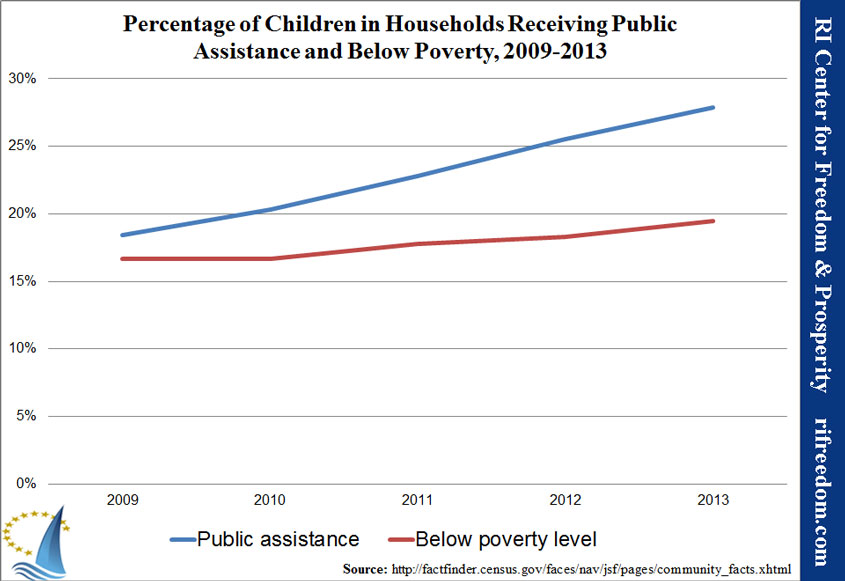
Obviously, the world is full of varied people, so any assumptions made at this level are just that: assumptions.  Still, recalling my observation, in August, that the increase of students in Providence schools came almost entirely from Hispanics who need extra help with English, the picture comes into focus pretty well.  The Census’s FactFinder tool can fill in some of the details.  From 2009 to 2013 — over the course of just four years — the percentage of children living in households receiving cash assistance increased by more than 50%.

RI-childrenpoverty-2009-2013

To deepen the picture a little, consider that the percentage of all families receiving public assistance increased by just 17%.  That’s still a big increase, but it suggests that Rhode Island’s population growth is in large part attributable to migration of poor, young families from countries to the south of the United States.

One needn’t be xenophobic to worry about the consequences of this demographic shift on the well-being of Rhode Islanders overall.  If Rhode Island’s economy were healthy and was therefore able to accommodate foreign families and empower them to lift themselves up, that would be wonderful.  More likely, though, like Lawrence, MA, we’ll continue to see government bring in new clients to turn RI into a company state, and somebody’s got to pay the bill.

RI More Oppressive than Afghanistan?

This part of a New York Times article about the flood of people into Europe caught my eye:

A quarter of Afghans told a Gallup Poll that they want to leave, and more than 100,000 are expected to try to flee to Europe this year.

What’s surprising about that is a comparison to other recent poll results:

Rhode Island ranked at the bottom of yet another national poll.

A recently published Gallup Poll found 42 percent of residents said they would like to move to another state.

Sure, this speaks to the proximity of better options and the ease of movement within the United States, but it’s still another red flag.

Turning Rhode Island into the Government, LLC, State

Rhode Island is stealing our opportunity to fulfill our potential and be self-sufficient. We’re becoming increasingly dependent on subsidies from government, jobs remain scarce, and the state’s latest programs are designed to make things worse.

Here’s one indicator of increasing dependency: From January 2007 to January 2010, the state added over 60,000 residents to the federal Supplemental Nutrition Assistance Program (SNAP; “food stamps”). Over the next three years, nearly 50,000 more joined, bringing the total to nearly 181,000.

In those few years, the state added about one-tenth of its population to the welfare program. Since then, during a supposed recovery, the number of participating Rhode Islanders hasn’t even fallen by 10,000.

During the same period, nearly 40,000 jobs disappeared from Rhode Island, and the state hasn’t quite replaced 30,000 of them. Joblessness or low pay subsidized with handouts appears to be the new normal in Rhode Island. As the crawling increase in jobs shows, we’re not achieving our role as a community to provide self-fulfilling, dignified work that allows us to support our own families.

Continue reading in the Providence Journal.

The Demon RI’s Cult of Big Government Would Summon

As Halloween approaches, fear not the masks and movies; fear the quiet promises whispered in press releases and incanted with mystical words like “equity,” “sustainability,” and “diversity.” The Cult of Big Government is working night in and night out to raise from the dark abyss of dangerous philosophies a demon to possess all of society and sap the human will.  Look south of Salem, to Rhode Island, where the scheme is well advanced.

In a society so comfortable that it has become discomfited by the wisdom of its ancestors, our popular myths mislead us now.  The demon will not arrive with a flash of lightning and the smell of sulfur.  It has changed the masks of racial bigotry and overt greed in which it has been spotted in the past.  Its minions have no need of the ritualistic dances of the legislature.  No virgin need be sacrificed (though virginity itself may be).  Surviving until dawn will not save the victims.

Rather, the secular clerics of the soulless cult have chosen three points in the lives of unsuspecting national villagers on which to build their citadels, disguised as places of public service, and when the triangle is fully drawn between them, all hope will be lost.

Continue reading on Watchdog.org.

UPDATED: Out-of-State-Trucker Revenue and the Effect of Tolls

Out-of-state truckers already pay taxes and fees on a per-mile basis, in Rhode Island, and new tolls could have a detrimental effect on revenue and the economy.

Pressure Builds in Providence… and Everywhere

Last month, I mentioned a complaint by Providence City Councilman Sam Zurier that the city government had finished the year, not with some of its cumulative deficit paid off as planned, but with an even bigger gap.  A chart about midway down this Dan McGowan article on WPRI shows what Zurier meant.  McGowan frames the story mainly in terms of mayoral politics:

Their game of finger-pointing had largely played out behind the scenes until this past weekend, when Elorza’s office claimed Taveras’s final budget “relied on a number of one-time fixes that were unrealistic and did not come to bear,” and Taveras fired back that the new administration “should focus on the choices it has made since taking office” to figure out why the city ran a $5-million deficit last year.

“Running a city like Providence is difficult,” Taveras told WPRI.com. “The choices an administration makes on a daily basis certainly have a significant and immediate impact on city finances and our future.”

Frankly, I’m still not sure what there was in the backgrounds of any of the last three mayors that would lead people to expect them to be able to run a city the size of Providence.  It’s as if voters believe that a mixture of bureaucracy and politics will ensure that a city runs well, leaving them free to vote for mayors based on irrelevant social policies or identity group affiliation.

Ted Nesi tweeted McGowan’s chart with the warning that the city has “zero room for error.”  A recession (or any number of possible calamities or probable economic shifts) will simply overwhelm the city budget.

Providence isn’t alone in this problem.  Our nation has been running on debt for three-quarters of a century, and for at least the past decade, any recovery Rhode Island has experienced has basically been built on dubious assumptions about the future, from pensions to the economy to government wisdom.  We make it from year to year just barely pushing the reckoning off into the future.

This won’t last.  Perhaps next year, perhaps next decade, we’ll all be wondering how we missed the signs.  The only relevant question, though, will be whether the pain and the promise of more will be enough — will be obvious enough — that the need to resolve our philosophical inconsistencies and political superficiality will overwhelm the urge for narrow self preservation.

When Government Has “Affordability” to Sell

A journalist once asked me what “other side” there could possibly be to the unmitigated blessing of government’s buying up open space.  I responded with the basic point that economist Thomas Sowell makes here:

Housing prices in San Francisco, and in many other communities for miles around, were once no higher than in the rest of the United States.

But, beginning in the 1970s, housing prices in these communities skyrocketed to three or four times the national average.

Why? Because local government laws and policies severely restricted, or banned outright, the building of anything on vast areas of land. This is called preserving “open space,” and “open space” has become almost a cult obsession among self-righteous environmental activists, many of whom are sufficiently affluent that they don’t have to worry about housing prices.

From progressives’ point of view, this is all to the better.  They get to preserve pretty nature for their own enjoyment when they have a moment to pause and look at it or to make their morning commutes more pleasant, and they drive up the price of housing, so they can then turn around and buy votes with subsidies to those who can no longer afford their homes while also increasing their power to tell people how they have to live.

Remember RhodMap RI?  It came before RhodeWorks, which (we’ll no doubt find) precedes RhodeKill.  Well, RhodeMap is an excellent example of the plan in action.

A poor economy, tight regulations and zoning, and a growing portfolio of unavailable land are making it difficult for lower-income Rhode Islanders to find suitable housing.  The solution, according to government planners, is to force social engineering by pushing “affordable housing” into every corner of the state, which has the happy side effect for progressives of pushing people who tend to vote for their preferred candidates and policies into those corners, so no contrary perspective can gain a solid footing.

When implemented, RhodeMap-like plans will drive up the prices (and taxes) in areas that aren’t in the designated subsidy zones.  The subsidized areas will fill up, first, with politically preferred groups.  This combination of circumstances will create many opportunities for strife, among them being an increase in the sense of inequality and unaffordability, which will — surprise! — increase the calls for government to step in and solve the problems with new taxes and diktats.

It’s a fine machine, don’t you think?

Growing Programs Versus Saving Money in Waste, Fraud, and Abuse

A recent report from the federal Government Accountability Office noted that “improper payments” through government benefit programs have increased dramatically–by more than 300 percent from 2003 to 2014, reaching $125 million.

Eliminating “waste, fraud, and abuse” has become something of a go-to promise for political purposes, often as a hypothetical funding source for desired programs. But taxpayers should be wary of bureaucratic attempts to trim spending around the edges; tendencies will always be toward more money transferred out of their pockets.

As a matter of simple mathematics, erroneous payments can increase for one of two reasons: Either the size of the program grows, or the error rate increases. If a strategy for reducing the error rate results in a much larger program, then it will wind up costing more money. The State of Rhode Island is on the cusp of proving this principle.

Continue reading on Watchdog.org.

How to Add Construction Jobs for Younger Workers

A brief article in the Wall Street Journal concludes that, nationally, a significant part of the disappearance of construction workers has to do with a gap in the supply line.  (We’re putting aside, I guess, the degree to which illegal immigrants have pushed part of the construction industry out of view.)

By supply line, I mean new, young workers:

The two researchers also looked at industry hiring to come up with another possible reason for a tightening labor market within the construction sector: Simply, construction companies didn’t hire enough young workers.

“The percent of hires accounted for by the 19-25 age group declined from approximately 18% at its peak before 2006 to 13% in 2012-13,” Janicki and McEntarfer said. “In comparison, the composition of hires of workers in the 25-34 and 34-44 age groups shows much more modest declines over this time period.”

During my construction years in a growing shop, I worked with a number of young guys.  A good number spun out of the job because it could be difficult and uncomfortable.  Some chugged along with it as the best available option, at the moment.  And some (like me) quickly advanced in the ranks, investing in tools, to become full carpenters and even foremen.

Young workers, in short, are a gamble for construction companies.  At a time when employees are plentiful (and willing to take less money), contractors will prefer more-seasoned guys who are more reliable and more flexible and advanced in what they can do and who have more of their own equipment.

That tendency could be reversed, though, if the industry were more free.  That is, if the government licensing, regulating, and permitting processes weren’t so burdensome, if employers were free to pay employees what employees are willing to work for, and if the policies for public projects weren’t so tilted toward labor unions, then individual tradesmen could start their own small crews, relying on help from younger men and women, and build up both the companies and the employees to their unique potential.

But we don’t like freedom and its benefits anymore in Rhode Island or the United States, apparently.

A Future with Tolls, in Rhode Island

The now-probable imposition of tolls across Rhode Island may be the linchpin of calamity for the state.

Speaker Mattiello, Why Give Gina Raimondo’s Political Career An Enormous Boost Via Tolls?

Dear Speaker Mattiello: I listened with interest to your interview yesterday morning on WPRO with Gene Valicenti in which you said that you support “a” toll plan. We won’t linger on the reasons why a toll, of any amount, on any vehicle, would be a really bad idea economically and politically for everyone in the […]

How Assumptions Get Buried in Economic-Theory Derivatives

Through the randomness of Twitter, I came across a post by Jacob Mortenson, who is currently working on a PhD in Economics at Georgetown.  Apparently, he had previously posted a chart showing the large gap between federal government spending and federal revenue (aka, the federal deficit), finding it to be historically large.  Somebody else suggested that he should redo the chart adjusting the numbers for inflation and population growth, and in this post, he does so.

He ends with a “mea culpa,” saying “we have returned to deficits that are roughly on trend.”

Not being an economics PhD — or even a candidate for one, in the foreseeable future — it seems to me that he gave in far too easily.  At some point, a field of inquiry gets to the point that it is speaking entirely in intellectual derivatives, without questioning whether they should apply.  (It’s sort of like failing to question the true value of derivatives from mortgage-backed securities.)

Yes, the population has grown and prices have risen since the 1980s, but why does that mean the economy can tolerate a proportional amount of government over-spending?  Why does government get to put that thumb on the scale?

Some time ago, I suggested that inflation is a willingness to pay more for the same things.  Why should people’s willingness to pay more for quotidian items mean the government should be able to continue spending proportionally more than it takes in?

And if the population is growing, shouldn’t the government be spending proportionally less while taking in proportionally more in revenue?  The activities of the military, for example, don’t increase just because they’re defending more people back home, and a larger population should generate more wealth; if it isn’t, maybe that’s a problem that’s relevant to the discussion of deficits.

None of this is to say that tolerance for deficits should have nothing to do with the cost of goods and the number of people, but simply adjusting for those considerations and declaring, “OK, we’re good,” shirks a whole lot of intellectual responsibility.  Worse: The shirking serves to benefit big-government, progressive arguments, as if government’s role in society is as a proportional economic actor.

September 2015 Employment: Back Down Toward Reality?

September marked the month that Rhode Island employment stopped its unabated month-to-month growth in 2015, but a downward revision of the whole year should still be expected in January.

Obama Years, Boomtime for Improper Benefit Payments

This Government Accountability Office report on improper payments through government programs — the much-mentioned “waste, fraud, and abuse” in benefit programs — makes for interesting reading.  Note the huge jump from 2007 to 2009:

GAO-improperpayments-2003-2014


To some extent, the upward swing simply reflects the growth in such programs with the combined causes of a significant economic recession and the election of a big-government progressive president, whose party controlled both chambers of Congress during both of those years.  Rhode Island’s a bit of a uniquely unhealthy example, but the SNAP participation highlighted in this space last week illustrates the larger trend.  The upward jump in improper payments last year, however, isn’t explained by a recession or a unitary Democrat federal government.

According to a pie chart in the GAO report, nearly half (48%) of the improper payments in 2014 were made via the Medicare program for the elderly, followed by the earned income tax credit (14.2%) and Medicaid (14.0%) programs for the financially troubled.  The rest (23.7%) comes from all the other programs, such as SNAP, unemployment insurance, supplemental security income, and school lunches.

The report gives suggestions for reducing the bleeding of money through these programs, but none would be as effective as shrinking their overall size, nothing would accomplish that as well as improving people’s opportunities, and nothing would create opportunity as well as lower taxes and increased freedom.  What the chart above arguably most illustrates is that progressive policies will put a society in a self-reinforcing downward spiral every time.

The Dreaded Cheap Energy!

Oh, horror of horrors!

The trend is expected to continue this winter, putting even more money in people’s pocketbooks and smoothing over price spikes caused by inadequate natural gas pipeline capacity in New England, officials say. The latest Maine survey put the average heating oil price at close to $2 per gallon, about 50 cents lower than the same time a year ago.

A combination of lower energy prices and a forecast for a warmer winter will mean savings of 18 percent for propane users and 25 percent for heating oil users over last winter, according to the Energy Information Administration.

What’s so bad about that, you ask?  Well, according to the article “officials” are “worried” that people will take their eyes off the renewable-energy, climate-change ball and use their savings for things like building their businesses and supporting their families.  If they get too comfortable, they might even start to question their votes for politicians who peddle big government in the name of saving the world.

Bottom line: If the first thought of “officials” upon hearing that the people whom they rule will have an easier time making through the winter is that those people will be less amenable to following the officials’ commands, then the people aren’t really their first concern.  The headline and lede of the article should have been: “Rhode Islanders to Save Money on Energy: Government Worries About Loss of Power.”

Competing Paternalism and RI’s Death Spiral

Kevin Williamson gives some interesting thought to getting people from welfare to work.  The contrarian hook is that he’s coming out in favor of more employer paternalism and perhaps even something resembling the old company-town model.  But the upshot is an encouragement to out-of-the-box thinking.

Why not, for example, change the structure of unemployment insurance?  Rather than have a possible total on which the person can draw down until it runs out, let the person get some percentage of any unused balance as a lump-sum check after he or she finds (and holds) a job.  Now, I can think of a number of potential pitfalls to such a policy, but it has some beneficial features.  For one, it could flip the natural human impulse to strive for the biggest nut one can get; whereas, now, the unemployed person can feel as if he or she is losing out on “free” benefits by finding a job too quickly, that person would, instead, feel as if he or she is losing a bonus with each week’s small check.

Williamson’s focus, though, is the possibilities of the large check.  A person could pay off a lot of debt with a big check, including debt that he or she accumulates while preparing for, easing into, or relocating in order to find new work.  This brings to mind a quick item I posted in 2007, titled “Go West, Young Welfare Recipient.”  At the time, employers in Montana (among other places) were raising low-end salaries quickly because they couldn’t secure enough workers, so I suggested that we should stop contributing to low-skilled workers’ inertia in our struggling Ocean State economy and instead direct them west.

Williamson likewise takes for granted the desirability of having people relocate for work.  That’s where I think he misses a big, important piece of the puzzle.

As I observed a few weeks ago, with reference to Lawrence, Massachusetts, governments and their economic satellites are deeply invested in the notion that nobody should move beyond the reach of their own paternalism.  This paternalism may be expressed in charitable terms — “People shouldn’t have to leave their homes in order to make a living!” — but it’s ultimately self serving.  If Rhode Island were to have fewer needy people for any reason, but especially because they moved to other states with jobs on offer, then Rhode Island’s government-and-service complex would have to shed jobs and power.

Once again, we come to the same ol’ prior problem.  We need government that responds to the real needs of the people who live within its boundaries, not the institutional needs of the government, itself.  Unfortunately, those who prioritize the latter have much more incentive to be politically active, and the system has therefore become rigged.  As a result, people who are unable to make Rhode Island work for them and who don’t want to become dependent on government become the ones to leave the state.

This is what people mean when they talk about “a death spiral.”

The Hot-Head’s Told-Ya-So

For a variety of reasons… I know… there are folks doing their best to do best by the state of Rhode Island who would like very much to be able either to ignore me or to say that I’m wrong, whatever I say.  Much to my own dismay, frankly, I’m not wrong as often as I’d like to be.

Note this item from Ian Donnis’s weekly Friday column:

Rhode Island’s unemployment rate dipped again in September, even as the state continued shedding jobs. Meanwhile, the ProJo’s Kate Bramsontook note this week of a worrisome trend: “While population has been stagnant, there is evidence that qualified individuals are leaving the state, which reduces the pool of qualified labor.”

Look, this isn’t rocket surgery. Progressives ’round these parts like to attack my credentials; I was a carpenter when I looked at the data honestly and began writing about Rhode Island’s loss of the “productive class” years ago.  This is obvious stuff.  Anybody who pretends it isn’t obvious wants to avoid the inevitable conclusions.

Rhode Island needs to stop electing big-government, insider-focused Democrats (or Republicans, for that matter) and give people the freedom to act in their own self interest.  The folks in power — whether they’re politicians, locally respected businessmen, or journalists — have been misleading everybody about the way the world works and killing the state.  They’re trying to preserve a fantasy that lets them believe the world is as it isn’t and (more often than not) gives them financial security in the process.

It isn’t a sure thing that Rhode Island can even be saved at this point, but it’s worth a try.  Start learning lessons, please.  If you need some incentive, consider that a right-wing carpenter is able to out-predict you by the better part of a decade because you won’t acknowledge the truth.

Foreign Aid Not Always in the Best Interest of Poor Countries

It might shock progressives and mainstream liberals to hear a Nobel-prize-winning economist say such a thing, but it really isn’t all that radical to note that foreign aid may not always be in the interest of the people of poor countries:

The effect wasn’t limited to Africa. Many economists were noticing that an influx of foreign aid did not seem to produce economic growth in countries around the world. Rather, lots of foreign aid flowing into a country tended to be correlated with lower economic growth, as this chart from a paper byArvind Subramanian and Raghuram Rajan shows. …

Why was this happening? The answer wasn’t immediately clear, but Deaton and other economists argued that it had to do with how foreign money changed the relationship between a government and its people.

Think of it this way: In order to have the funding to run a country, a government needs to collect taxes from its people. Since the people ultimately hold the purse strings, they have a certain amount of control over their government. If leaders don’t deliver the basic services they promise, the people have the power to cut them off.

The cost of providing aid to a poor person in an undeveloped or dictatorial society is inflated many times over not only by the lack of infrastructure, but also the need to pay off (in one way or another) the local thugs.  Moreover, alleviating some of the worst of the difficulties reduces the demand to make political changes, find sustainable economic activities, and build out infrastructure.

Aid can be an important piece of the puzzle of foreign destitution (although whether or how governments should be involved is debatable as a separate question), but it can’t be the only piece.  Moreover, we can’t let blurry notions of charity lead us to the cold, hard realities of the world.  (Note: That’s not a knock on charity; it’s a call for a mature charity that is focused on helping the recipient, rather than assuaging the emotions of the giver.)

Rhode Island’s SNAP-to-Jobs Gap

Since the recession began, Rhode Island has added about one-tenth of its population to the food-stamp rolls, and with jobs recovering slowly, the safety net remains full.

Economic Boom by Economic Modelling

I’ll be taking a closer look at the REMI study of Governor Raimondo’s Rhode Works proposal, but two quick thoughts based on Patrick Anderson’s article in the Providence Journal. First:

As it turned out, the study estimated that raising the gas tax would create even more jobs — 6,656 jobs over 10 years — than tolling alone, and $22 million more in gross domestic product.

REMI finds that government spending boosts the economy. It’s assumptions virtually guarantee that outcome.  The question of tolls versus taxes, or trucks versus everybody,  is simply a political calculation.

Second, the Rhode Works proposal calls for borrowing $600 million. Is it really a surprise that an economic model would find a half-billion-dollar boost to the economy? If you cash in a balance transfer check from your credit card, that’s free money in you pocket… until it isn’t free.  At some point, it becomes a consideration that the state will be paying almost as much in borrowing costs.  That initial boost will wind up costing $1,154.9 million.

Rhode Islanders have every reason to overrule a one-month study for which they paid $50,000 and say that more government revenue is not the answer.

The Powerless Always Pay the Bill

The economy can’t be manipulated, but the consequences (and the blame) for adverse outcomes sure can be shuffled around.

YOUR CART
  • No products in the cart.
0