What Job Creation Versus Job Destruction Says About Rhode Island’s Economy, Part 3 of 4
Looking at changes to income and wages in RI and MA begins to deepen the story of Rhode Island’s job market.

Looking at changes to income and wages in RI and MA begins to deepen the story of Rhode Island’s job market.
Blogger CoffeeBlack sees significance in the fact that Rhode Island seems to do OK for new hires, but is dragged down by too many layoffs. Looking at the changes of the businesses causing the hiring and firing, as well as their ages, darkens the picture.
Rhode Island’s unemployment rate may have “improved” below the 7% milestone, but the underlying data continues to give cause for alarm.
A new, anonymous commentator on the RI scene thinks detailed jobs data shows that it isn’t true that the state’s oppressive business climate is “stifling business investment and hiring.” Justin thinks that conclusion is wrong.
I’m not surprised by this news:
According to TINYpulse’s 2015 Best Industry Ranking report, gathered from its anonymous one-question feedback surveys from over 30,000 employees across more than 500 organizations, among 12 distinct industries, construction and facility service workers are the happiest employees.
Although, the big factor that isn’t even mentioned suggests that the survey creators and the reporter, Lydia Dishman, don’t have any experience, themselves, with that sort of work.
They talk about the fact that construction’s on the upswing, economically. They list things like supportive managers, having the necessary tools, and having “opportunity for professional growth.” They also mention the advantages of an industry in which employees kick back after work for the proverbial few beers. (The construction company with which I spent most of my time in the industry did this on Fridays.)
Readers might wonder, though, why any of these factors, other than the economic upswing part, don’t apply to every industry. Why should construction companies be more likely to have supportive managers? (That certainly wasn’t my experience.)
The biggest source of satisfaction in the industry, from what I observed, isn’t to be found in a management textbook. Rather, it’s the nature of the work. At the end of the day (most days), you’ve got something tangible that you’ve done. You can step back and look at the house frame that wasn’t there in the morning, the pattern of newly laid tiles, or the color contrasts of new paint. The electrician turns on the breaker and then watches light appear thanks to wires that he strung along the framing. The plumber watches the pipes he connected, like a connect-it building game for adults, hold water as it flows up the structure and then down the drains. Even landscapers (who are included) see the grass go from unruly to ordered with each pass.
It’s about the satisfaction of producing. If managers and workers in other industries want to learn something from the construction field, it should be the value of finding ways to make it appear that employees have something to show for their work at the end of the day.
This is one predictable result when progressives capture both state and federal governments:
The median house price in Rhode Island for 2014 as a whole was $215,000, the highest in six years, yet the number of sales was nearly unchanged — up only 0.25 percent compared with 2013, according to statistics from the state Realtors’ association.
For Rhode Island’s luxury market, however, 2014 was a very good year. For homes priced at $2 million or above, sales volume was up by more than 20 percent, according to John Hodnett, principal broker/owner of Lila Delman Real Estate. This small segment of the market is largely fueled by buyers from out of state.
The policies pursued by the likes of Barack Obama and Lincoln Chafee — whether regulatory, fiscal, monetary, or social — although sold as helping “the working people” wind up helping the very rich (sometimes making a whole new sort of person very rich). It’s an obvious consequence of the incentives and restrictions that they impose on the economy, so it seems likely to be deliberate… for any of them who aren’t intoxicated on the rhetoric that they peddle or of, let’s say, insufficient intellectual capacity.
Note, for emphasis, this line farther down the article:
“As property values build, it’s getting better,” McCarthy said. But another problem holding back the Rhode Island market “is the tax structure [high property and income taxes],” he added. “That’s the killer.”
As the snow closes in on you, this morning, take a moment to read Steven Frias’s article about barber protectionism in Rhode Island:
Some government regulations are excessive because they are designed to protect special interest groups rather than the public. Free-market economist Milton Friedman once explained that “the pressure on the legislature to license an occupation rarely comes from the members of the public” — rather, “the pressure invariably comes from members of the occupation itself.” The history of Rhode Island’s regulation of barbers exemplifies this.
More than a century ago, lobbying efforts were made by a barbers’ trade association to pass legislation to regulate and license barbers. Although the legislation was justified as necessary to protect the public health, The Providence Journal reported that it was also based on some barbers’ “desire to make more money than in the past by driving” lower-cost barber shops “out of business.” In 1903, the legislation was passed. Soon thereafter, some barbershops were shut down.
The example is not only an excellent one for Milton Friedman’s lesson, but also as an illustration of how Rhode Island government is killing the local economy and why the U.S. economy continues to experience an anemic recovery that can only be hidden for a time by easy money and massive amounts of government debt.
For whatever reasons of their own, some barbers are able and willing to ply their trade for a lower cost than their competitors, and some customers are comfortable with the arrangement. In other words, the market for haircuts has a space for low prices and minimal frills. Barbers who prefer higher margins push government to interfere, erecting barriers and passing regulations that make it impossible to play in that space.
Now substitute “barber” for any other profession. During times of economic hardship or readjustment, these lower-end markets would naturally grow. People have less money to spend on things like haircuts, and others need the work that such things can provide. Moreover, this doesn’t have to simply be the case for established professions; a similar dynamic can come into play for creative new directions for the economy.
But the protectionists and progressives don’t like this much freedom. They’d rather you struggle and suffer (and require the junky-hit of public assistance) than that you have the space to make your own, free decisions. So, we get heavy licensing requirements, workplace regulations, minimum wages, and on and on, until it’s nearly impossible to attempt something new. That’s especially true if you’re not the sort of person with access to big investment dollars and existing business connections. (One might say that we’ve reached the point, even, of protectionism for entrepreneurs.)
P.S. — If you don’t get the Sweeney Todd reference, see this old grainy clip of the original Broadway cast for a sense of the plot.
A pair of articles in yesterday’s Providence Journal give an excellent indication of why Rhode Island is the way it is. The first is about the receiver’s plan for firefighters’ new employment deal with the Central Coventry Fire District. The details of the plan are definitely interesting, but the key part, in my view, comes at the end:
The union will contest the new terms in bankruptcy court.
“We’ll out-lawyer them and outspend them and out-fight them,” Gorman said.
Think of the structural conditions — political and legal — that underlie that threat. A financially struggling fire district must balance legal fees against the employment packages that the union is protecting. Meanwhile, the union is fighting with money absorbed, at the point of the taxman’s gun, from local residents. Can we agree that the union’s ability to “outspend” the employer (if true) is a pretty good indication that maybe the union has gone a bit beyond fixing a supposed imbalance between employer and employee?
The second article is about some hires by the new general treasurer of Rhode Island, Seth Magaziner:
Treasurer-elect Seth Magaziner has announced another round of staff picks, including Tom Sgouros as his senior policy adviser.
Sgouros, who waged a short-lived 2010 campaign for treasurer, describes himself as an engineer at Brown University and a freelance writer and public policy consultant who has consulted in Rhode Island, Pennsylvania, California and Vermont “on public finance, banking, tax policy, and sustainable economic development.”
Reporter Kathy Gregg leaves out the important background that Sgouros is one of the central spokesmen for Rhode Island’s far-left progressives. (For fun, rewrite Gregg’s second sentence as it would appear if some conservative treasurer had appointed me as senior policy adviser.”)
In fact, we’re watching a whole generation of far-left progressives work their way into state government positions. In 2013, then-Governor Chafee hired progressive activist Kate Brock, for example, and even the supposedly conservative Speaker of the House Nicholas Mattiello (D, Cranston) hired RIFuture founder Matt Jerzyk to his legal staff. That hiring produced this statement, which can’t help but resonate oddly for long-time followers of Rhode Island’s Left and Right:
“Matt’s experience in city and state government will be a valuable addition as we continue to focus on growing the economy and creating jobs,” Mattiello said in a statement.
How exactly are our leading elected officials planning to “grow the economy and create jobs” with staffs full of progressives? Whatever the answer to that question might be, the two articles from yesterday’s paper illustrate the left-right punches by which progressives implement policies and insiders, like public-sector labor unions, benefit from the unfair rules of the game.
The next round of RI’s political history has only just dawned, but it’s a safe bet that we’re entering four more years of what the last four brought, more or less.
Mark Krikorian points to a study by Steve Camarota and Karen Zeigler, of the Steve Camarota and Karen Zeigler, showing that all net employment growth since 2007 has gone to immigrants, nationwide. Krikorian emphasizes that immigrants aren’t to blame for seeking opportunity, but policymakers are, for failing to match immigration to national economic needs.
A quick Monday morning search didn’t turn up sufficient data to repeat the research easily for Rhode Island, but a couple of sources give an indication that the story is much the same, here. The table at the end of this Tennessee iteration of the report shows that Rhode Island’s labor force participation rate for U.S. natives fell from 80.1% in 2000 to 75.6% in 2014, a 5.6% drop, while the native employment rate fell from 76% to 68%, a 10.5% drop.
Historical data for all Rhode Island employment puts those rates at:
We’d have to know the percentage of native versus foreign-born people in Rhode Island to figure out the actual numbers. Rhode Island’s terrible employment situation for the past seven years also makes the numbers a little more muddled than the national scene. Be that as it may, it’s clear that foreign-born Rhode Island workers are making gains versus U.S. natives in Rhode Island — at least when it comes to having a job. Otherwise, the native-born population would be doing as well as or better than the overall population.
It makes intuitive sense that Rhode Island would share the nation’s problems, and that they’d probably be worse, here. After all, the economic policies pursued by the Obama Administration — including loose money and loose immigration — have fostered economic disparity, with the upper crust prospering and everybody else on the decline, including the working and middle classes. Rhode Island’s ruling class likes to amplify all of the bad decisions made by its national counterparts, so we can be expected to be doing even worse.
Thanks to John Loughlin for having me on his special-edition, day-after-Christmas WPRO radio show, this morning. Between a late night of wrapping, a baby coming down with a cold, and older children who began trying to sneak downstairs at 2:00 a.m. on Christmas Eve, the past few nights have been light on sleep, so my mind was not prepared to continue making a subtle point on energy policy at the same time that it occurred to me that a tuxedo-wearing doll sitting on the host’s microphone looked a bit like Cool Keith, the producer.
Apart from that one lost train of thought, though, and with a huge assist from well-informed callers, the hour and a half passed enjoyably and brought us to three core points about the cost of energy in New England:
To address a couple of loose ends, I didn’t have the information ready at hand when one caller asked, but according to the RI Center for Freedom & Prosperity’s Competitiveness Report Card, Rhode Island’s cost of energy is generally in line with its neighbors in New England. It depends what how the comparison is made whether we’re toward the front or the back in the region, but New England tends to be toward the back of the nationwide pack when it comes to energy. As I told the caller, the area simply needs a greater supply of energy.
I also didn’t manage to put the final touch on a point about the relative costs of different energy sources. The interest groups ultimately don’t mind driving up the cost of energy, because the higher traditional sources become, the less outrageous “green” “renewable” energy seems. But that isn’t the whole story. It may one day become preferable for a business to put in solar panels and wind turbines, versus gas or other energy sources, but it may also become economically preferable for the business just to locate elsewhere — in or out of the United States.
A lot of these sorts of conversations about policy in Rhode Island come back to that option.
Once again, Rhode Island’s unemployment rate has drifted down, but once again it has done so in a way that bucks the national trend of employment gains.
Yesterday, the takeaway about Governor-elect Gina Raimondo’s plan for an economic summit was that most of it would be closed to the news media. Today, it’s that she has relented and decided to open the doors to the whole thing. That’s for journalists. It’s still a closed event in the sense that only invited guests can participate in the sessions, and that’s a problem indicative of the entire strategy of Rhode Island’s ruling class for our shared economy.
The purpose of this summit, per Raimondo’s spokesman, appears to be not to better understand what Rhode Islanders need, but to get some expert feedback on how to supply the things that Raimondo already presumes to know that Rhode Islanders need:
He said the media is invited to the beginning of the meeting because Raimondo wants reporters to hear the “assignment that she’s laying out for the evening.”
Because people have asked, I’ll say that I’m not aware of anybody I know who was invited to participate. We’re not, apparently, among Raimondo’s understanding of the top 80 “thought leaders” in the state. (How many articles and TV news segments have to appear about one’s ideas to count as qualification for being a “thought leader” has not been explained.)
As I’ve been saying for years, now, Raimondo is a progressive. In terms of organizing society, that means that she likely sees society in terms of groups of people, and progressives tend to organize by finding (or appointing) people who are treated as representative of their groups.
The theory is that those representatives bring the concerns of their peers back to the central planner, who weighs all of the feedback according to his or her sense of balance and makes decisions for the good of the whole society. Two problems with this approach are obvious (at least to anybody who’s watched Rhode Island operate for any length of time:
In short, it appears that Raimondo intends to formalize as official policy the approach that is destroying her state. Of course, that assumes that this isn’t all just window dressing around her plans to do whatever she wants to do for political reasons.
I bought a basic cell phone for my grandmother, last night. As the clerk in the Massachusetts store was adding the phone to my family plan, he remarked, “Wow, you pay a lot of taxes! Oh, you’re in Rhode Island.”
With that anecdote in mind, this morning, I’d suggest that Rhode Islanders should be wary of advice from an economist who admits that (according to Kate Bramson of the Providence Journal) she’s “puzzled” that Rhode Island’s largest sector, education and healthcare, “is failing to enjoy the growth it’s seeing in the region and the country”:
“… it seems like there’s this party going on in education and health services,” she continued. “And Rhode Island is not at that party, so I’m not sure why that’s not happening in this state.”
Could it have anything to do with Rhode Island’s heavy regulations and taxes, maybe? Could it have anything to do with the fact that Rhode Island leads the country in health insurance mandates? Could it have anything to do with Rhode Island’s teachers’ unions being toward the front of the national pack in their power, especially in political activity and the resources going to the union and union members?
Also on the front page of today’s Providence Journal is a Jennifer Bogdan article about Governor-elect Gina Raimondo’s visit to the White House. Although the visit, alongside other governors, was mainly a photo-op and meet-and-greet, Bogdan writes, “There were also a few moments for cake.”
Raimondo brought the president a slice of Death by Chocolate Cake from Gregg’s restaurant. Isn’t that just perfect?
While Rhode Island is failing to join the economic party, the woman who will soon be governor is bringing cake to the president and kicking off her big economic strategy:
“My focus all day … my constant question was, ‘What can you do to help get Rhode Island back to work?’ ” Raimondo said. “I’m going to be very aggressive about knocking on doors.”
In other words, her economic strategy is to be a salesperson, not to change the underlying problems. That won’t work. The problem isn’t that business people around the country don’t know Rhode Island is here. It’s that they know what Rhode Island is all about. It’s all about cake for insiders and shackles for people who want to bring their own little circles of the economy in a personalized direction.
Decreasing taxes, regulations, and mandates and allowing broad school choice would bring the economic party to Rhode Island, but anybody hoping that Raimondo is going to go in the direction of freedom over insiderdom is probably going to be disappointed.
A story from yesterday and a story from today, both in the Providence Journal, raise the question of whether the people who operate Rhode Island’s government are capable of learning the lesson of our state’s predicament. (That they apparently haven’t learned it yet comes pretty close to answering the question.)
Let’s start with Randal Edgar’s story today:
Taking stances that could complicate the challenges facing lawmakers and Governor-elect Gina Raimondo, the Department of Children, Youth and Families, the Department of Human Services and the Judiciary are among the departments and agencies that say they can’t cut their way to a balanced budget.
Instead, they are seeking more money, or suggesting that some of their costs be assigned elsewhere.
The recurring theme is that the departments say they can’t make the necessary budget reductions without cutting into their staffing or programs, to which I say, “Well, yeah.” They’re going to have to cut. Government can’t be the one sector, in Rhode Island, that’s recession proof (or even societal-decline proof). Agencies are going to have to do less with fewer people. Sorry.
HealthSource RI is an excellent example of the problem. Reading Edgar’s article, it’s clear that implementing the ObamaCare health benefits exchange and the related expansion of Medicaid were terrible decisions. Like somebody addicted to gambling or credit cards, Rhode Island government has long been counting on a recovery that’s never going to come.
The good news is that the department heads’ complaint that cuts would be draconian are blowing smoke. Look to the RI Center for Freedom & Prosperity’s Spotlight on Spending report for tips on how a few tens of millions of dollars could be found easily.
For another example of why the cuts must be made, turn to Paul Edward Parker’s article about T.F. Green Airport, yesterday. Be sure to read to the end:
At the end of the day, though, there’s only so much [Rhode Island Airport Corporation President Kelly Fredericks] can do to boost passenger levels at Green. He needs sharp marketing, and plans to extend the main runway will help. But two more significant factors will remain beyond his control:
How will Rhode Island’s economy fare?
Will airlines change strategy to put more emphasis on secondary airports?
This isn’t complicated. If more people are doing business year round in Rhode Island, airlines will have incentive to increase direct flights, including from distant locations.
Every one of these stories related to the local economy in recent years has the same moral: Government must loosen its tax and regulatory grip on the Rhode Island economy so that we, Rhode Islanders, can find the best ways to put our talents and resources to use. When we’re thriving, the government can start to think about expanding again, but until that point, it ought to be in a hurry to get out of our way.
Aaron Renn’s belief that “the Greenhouse Compact was right” shows the missing piece in progressive analysis, and in Rhode Island governance.
Rhode Island’s employment picture was indeed “mixed” in October, but context makes it simply bleak.
A friend forwarded me an interesting and alarming e-mail thread with regard to RhodeMap RI. Below is the text of two of the e-mails, which went out this afternoon, followed by the author and his title. On Thursday morning, the State Planning Council will vote on a proposed Economic Development Plan which largely incorporates the […]
The following statement was received via e-mail this afternoon. Attached was a letter addressed to Kevin Flynn, Associate Director of the R.I. Division of Planning.
State Planning Division Faulted For Pursuing “Predetermined Result” With Little Economic Development Focus
Senators, Representatives To File Legislation To Correct Imbalance
State House, Nov 18 – A group of five Republican, Democrat and Independent legislators today called for a delay in approval of the hotly-criticized RhodeMap RI.
The legislators want to correct an imbalance that seems to exclude meaningful action to improve Rhode Island’s poor economic performance, something the State Planning Division has continually tried to characterize as the goal of the effort.
On one page of the Saturday Providence Journal Kate Bramson reported a “here we go again” story:
The Rhode Island Commerce Corporation paid $62,500 to the California-based Bridge Bank to keep The Corporate Marketplace current on a $3.75-million loan that the state guarantied in 2011 under a controversial state financial program.
Meanwhile, the Commerce Corporation is working with the company “to restructure the company’s financials and review all options,” with a goal of keeping the company “viable while minimizing exposure to taxpayers,” Commerce Corporation Executive Director Marcel A. Valois told The Providence Journal.
The North Kingstown company is one of four granted loan guaranties under the program that backed a $75-million bond sale to benefit former Red Sox star Curt Schilling’s video-game company.
Apparently, the big lesson that the state learned from 38 Studios was that the government shouldn’t hold companies to the job-creation benchmarks to which they pledged in order to get the money (and which were arguably the core selling point for the program in the first place).
Meanwhile, on another page of the same paper, Bramson reported on the wishlist of special arrangements that functionaries working on behalf of the state would like to put on the table to develop the land freed up through the I-Way project:
[Jan Brodie would] like no sales tax and no corporate taxes for projects built on [the land in Providence]. She’d like an “institutionalized , predictable” tax-stabilization agreement for city property taxes that would last at least 15 years…
She’d like some flexibility on the … obligation to pay back the bonds that were sold to … complete the final phase of the highway project. …
She wants an innovation fund…
Finally, she wants Governor-elect Gina Raimondo and Providence Mayor-elect Jorge O. Elorza to “hit the road,” traveling outside Rhode Island to seek specific businesses that might locate here.
Rhode Islanders need to start laughing these people out of the room and insisting on the much simpler (and more-conducive-to-freedom) plan of eliminating and stabilizing taxes and regulations for everybody in the state, while stopping the practice of incurring debt on which the government later requires “flexibility.”
Rhode Island needs to cut all sorts of taxes on everybody. However, it’s important for policy makers and the general public to ask questions about particular proposals. What’s the goal of a particular cut; who benefits; where’s the money going to come from?
Conservatives have periodically asked me about the proposal that House Speaker Nicholas Mattiello (D, Cranston) and Senate President Teresa Paiva Weed (D, Newport) are publicly considering — to exempt retirement and Social Security income from taxes. Although it may be popular to promise senior citizens things, the questions still apply. Regarding the goal of the policy, Providence Journal reporters Katherine Gregg and Linda Borg offer this summary:
Neither idea is new. But this year, the Democratic leaders of the House and Senate are both talking about how they can keep retirees — and their retirement income — in Rhode Island.
Given limit political ability to cut taxes, does this reform target the group (1) that’s most notably leaving Rhode Island and (2) that Rhode Island needs most to stay? I wouldn’t say so. The state has long shed many young, single, college educated residents. The largest losses by family type have been married families with children. Once again, our biggest and most important losses are from the “productive class” — people who are interested in using the local economy to change their time and talents into money. That’s what really grows an economy.
It helps that cause a little to let relatively idle people keep and spend more of their cash, particularly if it keeps them in the state, but it’s indirect and subject to bleeding. A retiree’s tax-cut-funded vacation in another state helps young working families in Rhode Island not at all. A retired couple that keeps its Rhode Island house, instead of moving, keeps a younger family from buying that house.
On the question of how the General Assembly would make up for the reduced revenue, it’s encouraging to see Mattiello talking about cuts in spending, but we should believe that when we see it. The state legislature has a habit of finding ways of shifting burdens around, rather than actually limiting the size of government.
Progressive policies (like increasing the minimum wage and funding public college expansion with debt) hurt the very people that they are supposed to help, but the prevailing narrative makes it difficult for folks to see.
So the city of East Providence has gone so far as to ban the sale of dogs and cats. Worse, it did so in a way that looks like the ordinance targeted a specific business:
The owners of an East Providence pet store asked a federal judge Thursday to strike down as unconstitutional a city ordinance banning the sale of cats and dogs.
The City Council on June 3 passed an ordinance making it a criminal offense to sell cats or dogs, just weeks after the Perfect Puppy opened its doors at 1235 Wampanoag Trail.
You know, folks are railing against mayoral candidate Vincent Cianci, saying that it would send a terrible signal about Rhode Island governance to elect him as mayor of Providence, once again, but I have to wonder whether that’s worse than headlines suggesting that people starting businesses around here might find themselves suddenly targeted by city ordinances and state laws that pull the rug out from under their investments.
Ultimately, I don’t think the courts should interfere with the ability of representatives to pursue such horrible policies and practices. That just moves them to a venue over which the people have less control.
Rather, the people of East Providence should take responsibility for their contribution to the bad reputation that’s driving Rhode Island into the ground and replace their city council with one that doesn’t see government as a way to pick and choose what our neighbors can do for a living.
This Tuesday, Rhode Island taxpayers will be asked if they are willing to pay an eye-opening $125 million, excluding interest, to construct a new building and renovate existing buildings at URI’s College of Engineering. Proponents claim it will improve Rhode Island’s workforce, but how many URI engineers are actually staying to work in the state, right now?
Last week, I pointed out that Rhode Island teachers lead the country in pay, when adjusted for the cost of living in each state — at least teachers in categories that tend to be overwhelmingly dominated by government labor unions. An obvious next question is what other categories of professions put Rhode Island at the top of the pay chart.
So far, I’ve only found one: “reporters and correspondents.”
At $60,871 per year, Rhode Island’s journalists make even more than those in Washington, D.C., where their peers take home a cost-of-living-adjusted $54,154. (In fairness, Washington reporters and correspondents make more in absolute terms, but it’s more expensive to live there, so the adjustment knocks their average pay down about $10,000, while it boosts Rhode Island’s by about $800.)
It’s interesting to note that “broadcast news analysts,” the only other category that I could find under the broad category of “journalist,” fall back to the 10-15 ranking range that seems to be Rhode Island’s overall home. (Note that these professionals make a little more than the “reporters and correspondents,” but their peers in other states surpass them.)
Some aspects of the news business might make Rhode Island unique. For instance, in a larger state, like Massachusetts, the salaries of urban and statewide reporters might be significantly diluted, in this data, by many more small-market, local reporters. The local reporters are toiling away in Rhode Island, of course, but there are fewer of them. On the other hand, Delaware falls in the middle of the pack, for this category, and Maryland is nearly last.
Disclaimers aside, the apparent fact that the Rhode Island socio-politico-economic system benefits journalists so disproportionately raises questions about why that is, and whether it indicates an occupational bias against the sorts of dramatic changes that the state so desperately needs. Folks can be forgiven for seeing a connection to some surprisingly status-quo-friendly endorsements from the Providence Journal, this cycle.
Rhode Island’s September employment story was one of “down.” The unemployment rate was down, but so were labor force and employment numbers.
Here’s the latest word on the major public works program related to the land in Providence formerly occupied by Route 195:
It’s the kind of project the I-195 Redevelopment District Commission and state economic leaders have long said they hope to foster on nearly 20 acres of prime real estate. In the spring, [Lawyer Timothy H.] Ehrlich’s team submitted a bid to the commission to create [a biotechnology] incubator.
But after working all summer, Ehrlich is convinced the project needs financial help from the state, and that the help must be more than the life-sciences tax credits outlined in the state law that created the commission.
No doubt a variety of people would jump at the chance to tell me I just don’t understand how these things work. Government must invest in economic development. Biotech is a growth sector, and an incubator will attract all those “well-paying jobs” that we hear about. Every other state is subsidizing this industry. And yet, somehow Rhode Island will become a hub, even though small and late to the game. Yadda yadda yadda.
Indeed, the article has Marcel Valois, the executive director of the Commerce Corporation (which was formerly the Economic Development Corporation that invested in 38 Studios), insisting that “the project would ‘absolutely’ help the economy.”
Still, I just can’t get past the plain-language description of this whole process. The government invested in a project to move a highway because it would free up all sorts of “prime real estate” that could be sold to raise money and make economically productive use of the land. Now we’re “investing” in the process of luring organizations to the property. Next, those organizations will need massive subsidies to get off the ground. And then the start-up companies that this particular project attracts as clients will need additional subsidies to afford its services.
I ain’t a biotech-investment guru by a long shot, but this has all of the common-sense markers of a bad way to go about economic development and all of the common-sense markers of a scheme for empowering government agents and enriching connected individuals.
Timothy H. Ehrlich is, according to Kate Bramson’s Providence Journal article, “very encouraged by gubernatorial candidate Gina Raimondo’s knowledge and background as a venture-capital investor.” He’s so encouraged, it appears that he’s given Raimondo’s campaign $1,500 since May 2013, although the campaign refunded $250 of that two weeks ago.
The name on the campaign reports is “Tim Ehrlich,” but the address given belongs to this $1.4 million property in Concord, Massachusetts, which is owned by “Timothy H. Ehrlich,” matching the article. The article also calls Ehrlich a “lawyer,” and the campaign finance reports list the donor as employed by Boston law firm Gunderson Dettmer, where partner Timothy H. Ehrlich “focuses on the representation of start-up, emerging growth and public companies in the information technology, biotech and medical device industries.”
Looking at the brief report that the RI Center for Freedom & Prosperity released, yesterday, showing some slices of employment data, something struck me about the numbers for labor force participation — that is, percentage of each demographic group that is either working or looking for work:
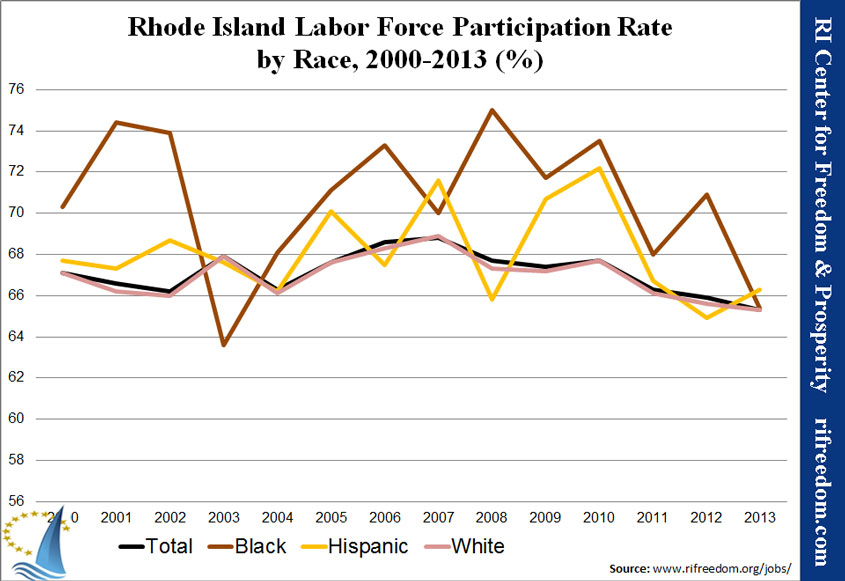
Notice that a larger percentage of black and Hispanic Rhode Islanders are either working or looking for work. Inasmuch as the unemployment rate (i.e., those who are looking for jobs) is almost two times higher for blacks than the average and more than two times higher for Hispanics than the average, we can infer that the higher labor force participation rates for those groups result mainly from the unemployed.
That makes sense, of course, because the income levels for these minorities tend to be lower than the average, so their need for jobs is greater. The gap between people’s need to work and their ability to find work is a humanitarian concern, but it’s also an indication of lost opportunity for our economy.
Here we see another indication of the harm that Rhode Island policies (and progressive policies more broadly) do to the productive class, no matter what race we’re talking about. These Rhode Islanders want to exchange their productive effort and their talents for money. Oppressive big-government policies make that exchange more difficult. High tax rates remove money from the economy and reduce incentive to expand productive activity (both work and investment), and invasive regulations make it more difficult to engage in productive activity legally.
It’s not surprising that minority groups are most profoundly affected by a wrong-headed approach to government. It is surprising, though, that the votes of different racial groups prove that they haven’t caught on to the abuse, yet.
Writing in the Providence Journal, John Kostrzewa notes that Federal Reserve Chairwoman Janet Yellen has an expanded view of her organization’s concerns:
…Yellen has another, perhaps more immediate concern that is holding back growth: economic inequality.
In a recent speech to the Corporation for Enterprise Development, she said: “We have come far from the worst moments of the crisis, and the economy continues to improve. But the effects of the recession are still being felt by many families, particularly those that had very little in savings and other assets beforehand .”
That declaration seems… well… convenient, considering that the current economic “recovery” engineered by the policies of Yellen’s organization and the current administration of the federal government has benefited exclusively the top 10% of income earners (roughly above $120,136 per year) and mostly the top 1% (starting just shy of $400,000).
Indeed, the whole dance takes on a bit of a sinister tone when you consider a recent story that’s gotten a shockingly small amount of play:
It’s an extraordinary document. There is not space here to do it justice, but the gist is this: The Fed failed to regulate the banks because it did not encourage its employees to ask questions, to speak their minds or to point out problems.
Just the opposite: The Fed encourages its employees to keep their heads down, to obey their managers and to appease the banks. That is, bank regulators failed to do their jobs properly not because they lacked the tools but because they were discouraged from using them.
I’d propose that it isn’t coincidental that the growth of big, nanny-state, central-planning government has coincided with a phasing out of average Americans’ benefit from economic expansion. Most of that expansion, after all, has been fueled by government debt, increasingly relying on investment schemes to translate into the economy. With the Obama Era, we saw the final switch flipped in ensuring that the losses of those schemes would be totally socialized, so that the investment class never lose in the deal.
The loop has closed, in other words, between the non-producing rich and the smooth-talking progressive politicians. The next step (perhaps that to which Yellen is alluding) is for the money handlers to increase the use of government to spread more of that unused wealth directly to constituencies so that they’ll be less tempted to overthrow the whole regime.
The cartoon version of The Lorax takes Seussian propaganda to the next level, most objectionably by vilifying poor and working class people who become upwardly mobile through enterprise.