Budget Growth and Household Income
Working with the federal government, the state government of Rhode Island has managed to keep its budget growing more quickly than inflation. The people of Rhode Island, however, have not been so lucky.

Working with the federal government, the state government of Rhode Island has managed to keep its budget growing more quickly than inflation. The people of Rhode Island, however, have not been so lucky.
Aaron Renn’s explanation for Rhode Island’s current condition has some worthwhile insights, but when he reaches for conclusions, he falls into the technocratic rut.
This (via Instapundit) is interesting:
Garthwaite et al. analyzed what happened in 2005, when the state of Tennessee discontinued Medicare health insurance coverage for about 4% of its non-elderly adult population, many of them nondisabled low-income adults without children at home. With a new need for private health insurance, which is often provided by employers, many of these people found new jobs. State employment rose by 6 percentage points from 2004 to 2006. This change mirrors the Congressional Budget Office projections of the decline in employment due to the expansion of public health insurance mandated in the U.S. Affordable Care Act.
Unfortunately, public schools have failed to educate generations of Americans not just about economics, but about critical thinking. Meanwhile, progressive deconstruction has undermined the more social means by which people learn how to think outside of the classroom.
The REMI model that the state used to promote dismissive projections for large changes to the sales tax is built on very similar, dehumanizing assumptions about how Rhode Islanders would react to changes in policies. If, for example, a reduction in revenue were to cost highly educated, well paid state employees their jobs, REMI assumes that they’d either leave the state or take much less money in one of the newly created retail jobs — not that they’d find similar jobs in the private sector or even create similar jobs by starting their own businesses. If (for some inexplicable reason) lawmakers didn’t address the revenue shortfall by removing the many government spending extravagances, and instead cut across the board, then REMI assumes people who would have received subsidized heart surgery and the like would simply go without it — harming the “economically impactful” healthcare industry.
In other words, the government would adjust its spending to mitigate harm to Rhode Islanders, and Rhode Islanders wouldn’t adjust their spending to save their own lives.
At some level of the lefty hierarchy, the people promoting progressive policies must realize what they’re doing, which means they want to further a cycle of dependence on government. Unemployment and human suffering are just temporary necessities to push people to the total dependence on government that is the only true route to nirvana.
URI economics professor Len Lardaro’s suggestions about how Rhode Island government should develop its economic policies takes a rosy view of experts and misses the critical structures of a democratic republic.
We can clear away one layer of confusion surrounding the 38 Studios reckoning by doing away with the euphemistic use of the term “bond insurance” in conjunction with Assured Guaranty’s role in the transaction. In an insurance relationship, an insurer commits to paying out agreed-upon amounts of money to an insured party, in return for receiving a premium from the insured, if certain conditions are met (and a claim is filed). If a valid claim is filed, the insurer doesn’t receive anything additional for paying it.
That doesn’t describe the relationship between Assured Guaranty and either the state of Rhode Island or the 38 Studios bondholders. Assured Guaranty has agreed, in return for an up-front premium, to pay a certain amount of money to the bondholders if certain conditions are met, receiving in return the right to do whatever the original bondholders could have done with the bonds. In other words, they will buy the bonds from the bondholders at a previously agreed upon price, regardless of their actual value.
In any objective sense, this doesn’t describe true insurance protection sold by Assured Guaranty, it describes a put option. In the textbook description of a put, the option seller agrees to buy an asset of fluctuating value at a pre-determined price, if its value falls below a certain “strike price” within a specified time-frame, in return for an up-front premium from the option buyer. The only difference between a basic put and the financial product sold by Assured Guaranty to the 38 Studios bondholders (that they paid for with money given to them by the state of Rhode Island) is that the condition-to-buy is not triggered by a price threshold, but by a missed bond payment.
No matter what term-of-art is used to describe it, what Assured Guaranty sold was a put option — and expecting the sale of puts to be risk-free is even crazier than expecting investing in start-ups or selling garden-variety insurance to be risk-free.
Justin and Bob Plain discuss the appropriate role of government in branding and promoting tourism in Rhode Island.
The search for external evidence of Rhode Island’s supposed employment boom continues, and continues to come up empty.
Yesterday brought another article (Zachary Malinowski in the Providence Journal) about the “innovative ideas” finding purchase with the “very young government” (as in officials’ ages) of Central Falls. This time, it’s a “Comprehensive Master Plan” developed by students at the Rhode Island School of Design and Brown University.
RISD landscape architecture professor Elizabeth Dean Hermann says the administration of Central Falls is mainly “learning through doing” and is very open to the suggestions of college students. That should make one wonder what sort of urban area young folks at high-end colleges would design.
What’s their point of reference? The people who actually live in Central Falls — with their own cultural habits, their own living circumstances, and their own income levels? Or is the redesign going to be based on things that college students and some other young adults who find themselves in control of a city would think are cool?
I’ve wondered this before. What I find interesting in this latest episode is that it comes with artists’ sketches. Notice anything about the folks enjoying the “beautification” of Central Falls.
Are worries about punishment by the ratings agencies and the bond market worries about individual decisions in a legitimate marketplace, or worries about collusion? If the answer to this question is based upon a fear that investors may decide amongst themselves to turn down money-making opportunities, to impose a boycott or to fix prices above a certain interest rate in order to make Rhode Island an “example”, then the answer is headed towards an allegation of illegal activity.
Those who have expressed concerned about “punishment” should be absolutely clear with the public about the mechanisms by which they expect individual, profit-seeking bond holders to leave money on the table, in order to make an example of Rhode Island, because it will never be cost-efficient, or moral, or in the best interests of the people of this state to accept either illegal collusion or leaders who would tolerate it.
Samuel Bell’s op-ed in today’s Providence Journal is hard to take seriously, but it must be taken seriously, because its like is doing terrible harm to the people of Rhode Island.
Calls to be “prudent” and pay the 38 Studios bonds miss the cost of allowing schemes that trap responsible people into paying other people’s commitments to work.
Under the rationale being offered for repaying the 38 Studios “moral obligation” bonds, Rhode Islanders would be justified in believing that the General Assembly and the financial ratings agencies are guilty of fraud against them.
I know there are more (and better) clips I could have used, but just for Friday afternoon fun, following up on Andrew’s post, earlier:
In a State House system designed to keep people apathetic, legislators voice strange economic ideas while business advocates advocate against the interests of their members.
With courage and careful planning the talisman of the state budget needn’t ward off the good spirits of sales tax reform.
It’s almost difficult to believe this article was reprinted in the Providence Journal:
The electrical system’s duress was a direct result of the polar vortex, the cold air mass that settled over the nation. But it exposed a more fundamental problem. There is a growing fragility in the U.S. electricity system, experts warn, the result of the shutdown of coal-fired plants, reductions in nuclear power, constraints on natural-gas pipelines and a shift to more expensive renewable energy. The result is likely to be future price shocks. And they may not be temporary. …
The problems confronting the electricity system are the result of a wide range of forces: new federal regulations on toxic emissions, rules on greenhouse gases, state mandates for renewable power, technical problems at nuclear power plants and unpredictable price trends for natural gas.
We’re dealing, here, with the predictable effects of regulation. Another passage provides a good illustration of government’s inability to predict the reactions of the private sector to its tape:
The federal government appears to have underestimated the impact as well. An Environmental Protection Agency analysis in 2011 had asserted that new regulations would cause few coal plant retirements. The forecast on coal plants turned out wrong almost immediately.
One suspects this factor wasn’t considered to be a very important a part of the regulatory decision-making process. After all, models show dramatic climate effects happening a century from now; why should it matter whether the government can predict economic factors a year or two out?
I wonder, too, whether there isn’t another factor, which one sees in progressive, big-government thinking more broadly: a simple inability to understand that people will change economic behavior. Energy companies — or any other companies — aren’t typically in business out of an innate drive to provide the services that they provide.
Business is a way of making money and supporting families. If the government makes it easier to do so by some other means, people will find those other means. And when the entire economy leans on what they used to do, everybody suffers.
These effects aren’t simple dollars and cents. They’re lost opportunities and damaged lives.
Justin and Bob Plain discuss the relative weight of free-market solutions versus regulation.
Yesterday, Rhode Island’s Director of Revenue Analysis Paul Dion tweeted a story that Rhode Island is one of only six states doing well by three measures highlighted by the S&P ratings agency:
So which states are prepared [for another recession]? S&P uses three measures to determine a state’s progress in its fiscal recovery: 1) whether or not general fund or operating fund balances are equal to or greater than the state forecast for the end of the 2014 fiscal year, 2) whether rainy day fund balances have been restored to at least their 2008 level, and 3) whether a state is funding its actuarially recommended pension contribution.
Based on those standards, six states are in the positive for all three categories: Indiana, Michigan, Rhode Island, South Carolina, Utah and Wisconsin.
I suggested that it’s not exactly a new story that the state government is making itself secure while the population languishes, to which Dion responded that “if state government does well your narrative is shot to hell.”
My reply is that the more important question is what does Rhode Island state government do well? Whom does it serve?
The S&P report is narrow in scope, essentially giving an indication of what investors should be considering when looking for bonds. I’d argue it’s too short sighted. Sure Rhode Island’s government might be ready to weather another recession (assuming the state ever really exited the last one), but what about its people?
Sure, the state government’s rainy day fund may be at its 2008 level, but its labor force is down around 20,000 people. The number of Rhode Islanders who say that they’re employed is down almost 30,000. Where’s their rainy day fund? Are they ready for another recession?
Brain imaging of managers offers evidence that a particular economic philosophy is on the right track (and others, not)
For a quick lesson in economics and history, take a few minutes to watch this Learn Liberty video featuring Deirdre McCloskey, a professor at the University of Illinois at Chicago:
There are two key points to the video, particularly relevant to the Rhode Island discussion.
The first is that progressives are incorrect to credit the turn toward progressivism and big government programs of the past century for the increase in general prosperity, as some did at the RI Center for Freedom & Prosperity’s debate last weekend.. The trend actually began around 1800, well before Social Security and the GI Bill.
The second is that neither exploitation of the masses by the elite nor top-down investment (whether Keynesian government-driven or free-market trickle down) is to credit. Rather, increases in economic liberty for everybody plus social and monetary rewards for being an inventor, discoverer, or innovator brought about the unprecedented boom in prosperity.
That makes sense. The economy, ultimately, is human activity, and human ingenuity is what brought new ideas, new systems for doing things, and previously unimagined products into being. And human activity isn’t best spurred at the tip of a whip or at the call of a meager paycheck. It’s encouraged by individual will and opportunity.
(Via Instapundit.)
The RI Center for Freedom & Prosperity has released its legislative scorecard and Freedom Index for the 2013 session of the General Assembly. In summary, everything got worse.
Not a single legislator improved his or her score. Some of them — including hard-line progressives — improved their rankings, but that was entirely because their peers did so much worse. The story of last year’s legislative session can best be consolidated in a single animated graphic.
This shows the Freedom Index scores of all legislators for the 2012 session and then the 2013 session. The 2012 session is the one in which there’s actually some space between legislators; the 2013 session (two seconds later) is the one that shows them moving toward consolidation down the drain.
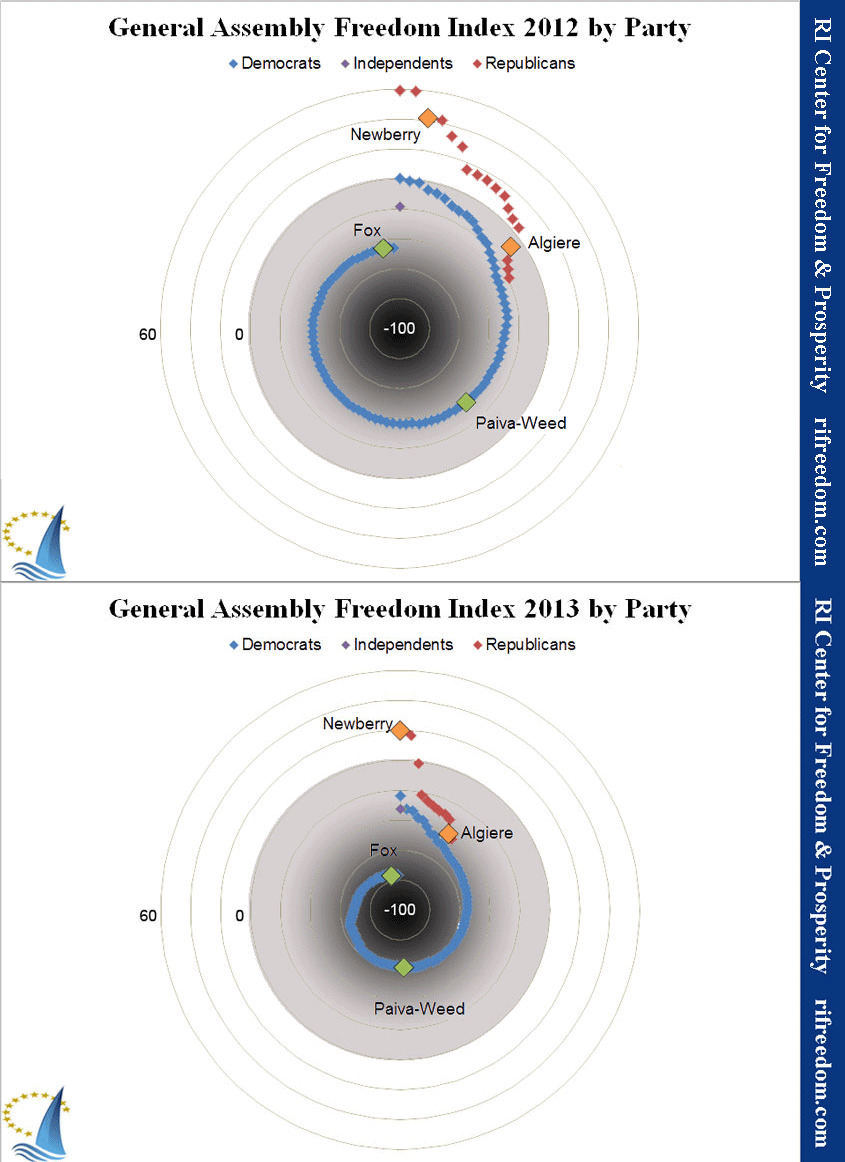
By way of a quick explanation, the Center considers all bills that receive a vote in either chamber, consolidating (as best we can) companion bills to only count once. With input from outside allies, we score the legislation on a scale from -3 to 3 in terms of freedom (mainly economic) and good government.
We then collect all of the legislators’ votes on those bills. A “yea” gets a +1, and a “nay” gets a -1. That way, voting against a bad bill still produces a positive score. The index is based on a percentage of the ideal legislator (from our point of view), so the total possible range is -100 to +100.
I’d note, too, that we found more bills worth scoring in 2013 than in 2012, and there were a lot more bills that almost made the cut.
To some extent, it can be said that former House Speaker Gordon Fox (D, Providence) and Senate President Teresa Paiva-Weed (D, Newport) brought more bad bills (and fewer good ones) to the floors of their respective chambers in 2013. After all, they almost never allow votes on bills that they aren’t positive are going to pass.
But that isn’t an excuse for legislators, because (obviously) they either could have voted against the bills or prevented the bills from reaching the floor by expressing an unwillingness to vote for them.
Anybody wondering why general employment stagnation in the Ocean State turned into a downturn in the late spring and early summer, last year, should consider the above graphic as one of the factors.
Ever the gracious adversary, Tom Sgouros takes to the Internet, today, to insult people who helped to give him a platform, and he bases his insults on stuff that he just makes up.
The evisceration of the Atlantic salmon is not a tale of free-market self destruction, but of society’s evolving needs and priorities, which are highly contingent on wealth.
A North Providence gym that was invited in and then shut down by local government illustrates the wisdom of avoiding economic activity where government’s role is overly strong.
Via Instapundit comes a brief must-read graduation speech from Nobel economist Thomas Sargent:
Economics is organized common sense. Here is a short list of valuable lessons that our beautiful subject teaches.
1. Many things that are desirable are not feasible.
2. Individuals and communities face trade-offs.
3. Other people have more information about their abilities, their efforts, and their preferences than you do.
There are twelve points, in total. Would that they were imparted to more college graduates.
Rhode Island (with the rest of the states) is apparently experiencing an employment boom, although the evidence is difficult to see outside of the statistics.
Ted Nesi tweets that state tax revenue data for March was down 26% from the expected $52.6 million, at $39 million, which Director of the Revenue Rosemarie Booth Gallogly calls “sobering.” That’s actually not the whole story.
The numbers Ted cites are actually just income tax. Looking at the monthly estimate to actual report from the office of Revenue Analysis shows that the $13,556,296 shortfall in income tax is only part of the $23,761,918 shortfall in all taxes, the $25,002,703 shortfall in total taxes and departmental receipts, and the total general revenue shortfall of $27,586,944. Almost every major tax was down, except the sales tax, by a little.
That’s more than the controversial annual cost of the HealthSource RI health benefits exchange. It’s more than twice the controversial 38 Studios bond payments. And it’s on top of projected deficits, expected loss of gambling revenue, and the budget-busting decision to lure more Rhode Islanders into Medicaid.
It’s important to note that the previous table, which shows year-to-date revenue isn’t quite as discouraging, yet. Total general revenue is only down $1.877,918 (-0.1%) for the year. Still, all of the data points accord with the shrinking workforce and an anecdotal sense that Rhode Islanders are just demoralized and giving up, as personified by a governor who seems most focused on starting his retirement speaking tour early.
I’d suggest that these holes can’t be patched, and that trying to do so will only accelerate the decline. The state needs a radical readjustment of its priorities, emphasizing the free economic activity of its residents. Rhode Islanders need a bold shot in the arm to give them a sense that things can turn around
More tightening of the leash and moving of the needle in the wrong direction can only hurt.
Another organization speaking out against the RI Center for Freedom & Prosperity’s Spotlight on Spending report appears to have a business model that charges dues for access to taxpayer-funded services.
On a personal note, I’d like to sincerely thank PolitiFact RI for starting my day with a big smile this morning, though perhaps they would not be altogether pleased at the reason.
In today’s Providence Journal, they’ve rated a statement by the Rhode Island Center for Freedom and Prosperity (hereinafter “the Center”) pertaining to the $224.5 million in wasteful spending identified by the Center in the governor’s proposed 2015 budget. PolitiFact is not questioning that the state gave away the $5,000 example offered by the Center of an expenditure item in the Governor’s Workforce Board from a prior year. PolitiFact is only saying that the Center did not fully explain what the $5,000 in hard earned taxpayer dollars was spent on.
Justin and Bob Plain talk about the pay differential between men and women.