
So, What Would You Do to Help the Poor and Save the World?: Framework

It’s well and good to spend some words attacking the premises of progressive policies and calling their supporters the intellectual progeny of slaveholders. But unless we’re willing to declare that we have no responsibility to each other, no Golden Rule, then we need an alternative approach.

Let’s start by defining (one, two) the economic universe as the total value that human beings attribute to existence, as measured by the maximum amount of productive effort that we could expend to live it fully. Some large portion of this total lays fallow, as economic “potential.” We can break this down again into smaller parts: Some of our potential is locked up in things we haven’t learned to do yet or psychological hang-ups we haven’t overcome; some of our potential we set aside for simple enjoyment, like hours spent in the yard tanning or simply conversing with loved ones.

The active economy, then, is what remains: the value that our society measures with money. (Remember that money is not value, of itself.)

The goal of social policy (in and out of government) ought to be the greatest possible realization of value from life. The active economy can be a good indicator — inasmuch as it shows how much people are motivated to work for things they value — but it’s not sufficient. Work is not the goal or the thing to be maximized.

Free-marketers often write and speak of the complexity of the economy, arguing that central planners can never have sufficient information, collected quickly enough, to guide an economy in a competent way. The conclusion is that we’re better off, as a practical matter, letting prices reflect value organically.

My framework, herein, not only compounds this complexity with all of the intangibles that make human existence valuable, but also makes central planning a moral presumption. The central planners aren’t only trying to balance the needs of the economy, they’re also presuming to pass judgment on what each person should find fulfilling in life, including to compromise it for some in the name of uncertain attempts to unlock the potential of others.
Of Automation, Economic Value, and Slavery: Minimum Value of a Wage Slave

Let me pick up the thread by acknowledging a major difference between slavery and the minimum wage — namely, the fact that the wage earner keeps the profit from his or her own labor. In slavery, the seller takes some of the value at the time of purchase and the owner takes the rest over time.

Objectively, that may not be as big a distinction as it at first appears. One supposes that some enterprising slaveholders in history discovered that they received better work when their slaves were well cared for, which could be seen as a form of bartering, without the middle step of cash.

Still, the core beliefs and logic with which we approach a topic will affect the sorts of solutions we propose when we find the system requiring correction. In that context, I’d suggest that the progressive mindset puts low-income people in the same box as their intellectual predecessors once put slaves.

The reason — more explicit with a “living wage” — is that a minimum wage is set as the minimum value of a human being’s time, not as the minimum price of the task that he or she performs. Somebody other than the worker is setting that price, and the worker is not permitted to determine that he or she is willing to perform the task more cheaply.

Those acting with cynical political motivation are essentially selling the human agency of low-income workers for the profit of votes. Those of a more charitable bent receive their profit as good moral feeling.

This presumption has practical, actual economic effects, and I think it follows naturally that policies that aren’t correctly ordered toward human fulfillment will inevitably produce bad outcomes.

However, my point is that we come up with a much different prescription if we recognize human beings as the source of value in the economy, with the autonomy to determine their own priorities for their “kinetic” economic energy as well as the degree to and manner in which they unlock their own potential.

The Rhode Islandification of the United States

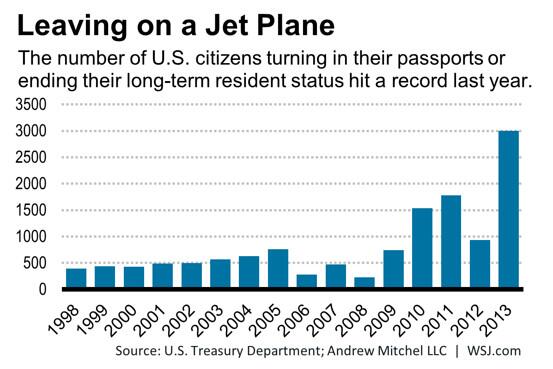
Wall Street Journal reporter David Wessel tweets the information that a record 2,999 Americans renounced their citizenship in 2013, mostly (he says) for tax reasons.

We should be clear-eyed about the fact that this is around one one-thousandth of a percent of the population (while admitting the likelihood that they account for quite a bit more of government revenue than that). Still, the stunner is the comparison to other years:

That’s a very dramatic change in the annual number of expatriates, almost like the canary in the coal mine of American hope. The dip during the election year looks like a pause to watch for signs of change.

Which makes me think of Rhode Island. On net, almost 4,000 Rhode Islanders left for other states, last year.

The Ocean State’s civic problems may be too deeply entrenched, at this point, for there to be any hope of a turnaround, but the rest of the United States should take the warning before allowing President Obama and Congress to continue moving the nation in our direction.

Of Automation, Economic Value, and Slavery: Man Versus Machine

Last time around, I closed with the assertion that a world of machines churning out products would essentially have no “economy,” because machines are indifferent. There’s no entity to value what they’re doing. It’s not an economy; it’s a process.

Put a collection of machines in the woods and watch them sit there. Put a collection of people in the woods and watch civilization blossom. To the objection that highly advanced machines — “universal constructors” — could theoretically build a civilization from scratch, perhaps even with some sort of creativity, I’d suggest that somebody would have to set the machines in motion, programming them with initial purpose. The value, in other words, comes from the developers.

There’s a point, in this line of as-yet imaginary “what ifs,” at which it would become difficult to make the distinction between mankind and machines. At that point, however, we must step away from logic and into theology.

Suffice it for now to say that at the definitional core of economics are beings (human beings) able to unlock their own economic potential, or to decide not to do so.

That principle is central to the evil of slavery. Even where, in history, slaves have been treated as well as paid servants might expect to be, we rightly recoil from the notion that they were no better than work animals or machines. They had no choice whether to work or what to do for work.

(If one were inclined to branch into an uncomfortable topic, it would be possible to begin making the case that there’s ultimately no separation between “fiscal” and “social” issues. My reasoning, above, applies at the biological level. A random cell placed in a womb will “sit there.” An embryo in the same environment will become a human being unless prevented from doing so.)

To return to the topic with which this series began, the irony is that those who proclaim the compassion of welfare, minimum wage, and such inevitably wind up conceiving of human beings in the same way as slave owners.

Concern for the Community or Preparation for Submission?

So the local Twitterverse has exploded with commentary on CVS’s decision to stop selling tobacco products, even though it will cost the chain $2 billion of its roughly $125 billion annual revenue.

Ted Nesi puts it in context of the company’s move toward the health-services space, what with the MinuteClinics that it announced an intention to open, in November. In Ted’s telling, it’s a peer-pressure, good-for-the-image thing, perhaps to defuse some of the opposition that had the clinics on the receiving end of Rhode Island’s infamous licensure blockade back in 2005.

Amy Payne, from Heritage, proclaims it as evidence that corporations can do the right thing without government coercion.

Of course, it’s also possible that the company has been given reason to believe that the government is preparing to change the rules of the game. One indication of that possibility is House bill 7166, which would prevent any “health care facility” from having a license for tobacco sales “issued, renewed, or maintained.”

It’s win-win. The government makes a threat, and the company gets to respond to that threat by shooting for some good publicity. The only losers are consumers buying the legal product from their local stores, taxpayers who find the government shifting the tax burden to other collections than cigarettes, and company shareholders whose stocks lose value to the extent that the company can’t continue selling a profitable product while also branching out into new healthcare services.

Tax Policy, Migration, and the Battle of Good and Evil in Rhode Island, Part 2

Jason Becker poses some questions to Justin on tax policy, government services, and the migration of Rhode Islanders.

Tax Policy, Migration, and the Battle of Good and Evil in Rhode Island, Part 1

Jason Becker poses some questions to Justin on tax policy, government services, and the migration of Rhode Islanders.

Perspective and Different Conclusions from the Same Data

By way of a quick follow up to my post on the state’s taxpayer-migration study, Ted Nesi’s related post, mostly quoting Revenue Analysis director Paul Dion, offers an excellent opportunity for some meta-analysis of how perspective affects one’s policy conclusions from a given set of data.

Dion plays it very close to the vest. More than once, he states, “That is significant.” But he doesn’t take the next step of telling readers why he believes that. Why is it significant that older, wealthier Rhode Islanders who were “movers” — that is, who continued to file tax returns in Rhode Island after changing their residences — were so much more likely to head to Florida?

Perhaps he’s thinking of the common wisdom (which I heard RI Foundation’s Neil Steinberg voicing the other day) that people migrate to Florida for the weather. However much that’s true for some people, it remains an important question: If the tax comparison were different, would they change their habits to remain in Rhode Island half a year plus a day, rather than the other way around?

Something similar arises with this:

As for Goners [those who left and never filed another RI return], the largest percentage was in the $200,000-to-$500,000 AGI category and was skewed younger than the Movers. This indicates to me that this group is likely comprised of executive-level professionals who relocate because of a new job.

Maybe Dion’s instincts are correct, and it’s easy to imagine status quo apologists concluding: “See, it’s not our tax climate; they’re moving for jobs!” But that’s not a relief; it’s a problem. Why aren’t those jobs here.

Dion also notes that Massachusetts becomes a more prominent destination for those who leave when one focuses on younger wealthy Rhode Islanders. That could indicate both that they’re taking jobs out of state because they want to stay within reach, but can’t find jobs in RI, and that they’re making their moves as a means of avoiding Rhode Island’s burdensome environment of taxes, regulations, and other mandates.

In any of these cases, how one approaches the data affects whether one concludes that Rhode Island can continue to impose its present burden on people in a mobile society.

RI Budgeting: A “Big Deal” Depends on the Politics

Saying that there’s been no “mass exodus” of wealthy Rhode Islanders makes light of the fact that they took $18 million in income tax revenue with them.

Of Automation, Economic Value, and Slavery: Inflation Versus the Tide

After devoting some thought to defining the economy, a critical, subtle question remains. If you invent something that inspires people to work in order to earn it, and they increase the human productivity in the economy, and then somebody automates what they’re doing, after which the population returns to its prior level of human activity, hasn’t what I’ve been calling the “kinetic economy” grown?

If we define the economy in terms of things produced, then obviously the answer is “yes.” But if we’re after a more expansive definition of the economy — one that allows us to assess all the numbers from above, rather than within — the answer is “no.”

Economic thinking seems currently to be bogged down observing economic factors and describing what they do, rather than questioning what they are. At bottom, what is inflation? The dictionary tells us it’s:

a continuing rise in the general price level usually attributed to an increase in the volume of money and credit relative to available goods and services

That’s serviceable for doing math problems, but what is it? Contrast that with the definition of “tide”:

the regular upward and downward movement of the level of the ocean that is caused by the pull of the Sun and the Moon on the Earth

If we were to wall off a bay and dump a whole bunch of stuff in it, the water level would go up, but it wouldn’t be the tide. The tide is the gravitation pull of celestial bodies on water. So what is inflation.

Well, a precondition for inflation is the existence of transactions, so we could rephrase the definition to say inflation is a willingness to hand over more dollars for the same amount of things. My object, here, is to suggest that the material measures of the economy mainly describe the flow of value. The total value — the definition of “the economy” — must come from elsewhere.

That source, ultimately, is people. Fully automate everything and then wipe out humanity, and there is no economy, because there’s nobody to care whether the machines keep going or stop.

10 News Conference Wingmen, Episode 18 (Eliminating the Sales Tax)

Justin and Bob Plain discuss the possibility of lowering the state sales tax.

Explaining the Economics of Bold Policy Changes

Rhode Island insiders and the progressives who love them don’t seem to want to talk about the real risks and opportunities of proposals (like eliminating the sales tax) that would help all Rhode Islanders.

December Employment: Rhode Island in Contrast

Rhode Island’s December 2013 results paint a bleak picture, and Rhode Islanders shouldn’t buy into the spin that it represented a blip in a general improvement.

Minimum Wage Bidding War By Raimondo & Taveras Swiftly Rebuked By Latest Unemployment Rate

On Thursday, citing his mother’s employment history (how could you say no to his mother, you hard-hearted person???) , gubernatorial candidate Mayor Angel Taveras announced at a press conference that a hike to $10.10/hour of the state’s minimum wage should be phased in by 2018. A couple of hours later, General Treasurer Gina Raimondo, who, […]

Of Automation, Economic Value, and Slavery: Defining the Economy

One point that arose in one of my recent posts about economics bears some elaboration: namely, whether machines can “impart additional value to the economy.” It’s a truism among folks with my general worldview that the economy is not zero sum, can grow without taking away from anybody, and grows with innovation.

The problem is that scope has to be defined. Clearly, if I’m selling comic books, there’s only a certain amount of demand. If I gain market share, my competitor loses it. On the other hand, if I create a product that people are willing to work to buy, I can get rich even as everybody else grows their income, too.

But I just smuggled something into the discussion. Those people no longer have the free time they once did, which gets back to the idea of a “potential economy.” At that level, there is clearly some maximum amount of economic energy, adding all of the value that people give to the total economy plus all of the potential value that they currently ascribe to non-economic activity.

Everything non-economic can be put in economic terms. How valuable is my faith, my love?

Some years back, I went in search of a definition of “the economy” that took this larger view into account and couldn’t find one. It seems most people are content to think of economics in terms of its general laws and consider something like GDP to be its measurement.

But that can only be partial. If, for example, we consent to massive government debt, for a period, to rev the economy toward some new innovation… say maximized production and distribution of food… once we’ve reached that target, we ought to be able to let the economy shrink and pay off our debt. People will be able to eat without having to work so hard.

Naturally, powerful people don’t much like that idea, though, because what it really amounts to is the masses cashing in their economic potential for some other good, like enjoyment of life.

Minimum Wage Talk, the Worst Sort of Pandering

GoLocalProv’s Kate Nagle cites RI Center for Freedom & Prosperity CEO Mike Stenhouse in her article, today, on talk of raising the minimum wage. As the Center’s report from last spring suggests, a minimum wage of $10.10 would destroy an estimated 3,466 Rhode Island jobs, and it wouldn’t affect the demographic that the politicians promote:

… 24,846 Rhode Islanders currently have jobs that pay them at a rate of $8.25 per hour or less. The “typical” profile … is of a white non-Hispanic high-school graduate, 21-years-old or younger and with no college experience, who lives with his or her parents and works 20-34 hours per week.

The Providence Journal’s PolitiFact crew contacted us a couple of months ago to fact-check that claim, but we haven’t heard anything since. (It doesn’t take much cynicism to think they’ve found other topics more interesting that didn’t require them to give the Center a “True.”)

But the economics aren’t really the key concern of most politicians. Rather, they want to say to a large group of people, “I will give you stuff.” Or, more accurately, “I will make other people give you their stuff.”

The part about 3,466 people losing their jobs kind of disrupts the narrative.

Politicians have internalized as a moral given that this redistribution is allowed and appropriate. We’ve permitted them to conclude that they have a right to take our stuff away, or force us to give it away.

The only question, then, is whether you’re in the disfavored group that ends up giving more than you get back. One suspects that individual answers to that question help explain who’s leaving our state and region for other states and who’s coming here from other countries.

For the people making the top-down decisions — politicians and bureaucrats — the most relevant question isn’t whether this flow is good for the economy, but rather, whether it transforms the population into one that will vote for them and their massive budgets.

How the Minimum Wage and Welfare Help the Rich: Competition

So — hypothetically — we’ve got the entire grocery store industry fully automated, and the question is to where the extra profits will flow. With a large displaced workforce supported by unemployment and welfare, the government has alleviated some of the demand-side pressure on prices by handing out the money to keep paying current prices on food.

But pressure on prices can come from the other direction: competition.

A grocery store that simply divvies up its greater profits among a few executives and stakeholders will be at a competitive disadvantage to one that passes much of the savings on to consumers. That displaced workforce still has only limited income, so a store that can save the average family $50 a week will draw shoppers far and wide.

If that doesn’t happen, then something in the system is preventing it. In an industry like health care, it’s easy to see that regulations and mandates make entry and innovation difficult. In an industry like heavy construction, unionization keeps the largest area of cost (labor) fixed. In other areas, licensing and other hoops create the blockage and minimum wages and benefits keep up the cost of labor without unions.

The great bulk of these complications begin with or are exacerbated by government. That makes sense, too.

Established businesses, labor unions, and other special interests are already organized and powerful. Therefore, they are better able to influence the democratic and not-so-democratic processes of government.

Government, which progressives like to see as a counterbalance to private power, simply comes into line with it and amplifies its reach. A managed economy — with both direct decisions of government and public-private efforts to move the economy toward the upper crust’s vision of the future — inevitably favors the powerful and influential.

They limit competition and also ensure that there are mechanisms (including loopholes) that keep them from bearing an equal share of the burden of the income redistribution that keeps their prices up.

(more later)

The “Business Voice” on Legislative Commissions

The Providence Chamber of Commerce joins those who think of government revenue first.

10 News Conference Wingmen, Episode 17 (Economic Development by Their Rules)

Justin and Bob Plain discuss economic development and whether Rhode Islanders should be made to fit a government-driven top-down mold.

Government Revenue Analyst Implies Getting People to Quit Is Job Growth

The state’s director of revenue analysis offered misleading testimony concerning the state’s unemployment rate as a member of the commission to study the elimination of the sales tax.

How Minimum Wage and Welfare Help the Rich: Where’s the Profit Go?

Following up on yesterday’s post on the “potential” and “kinetic” energy of economic activity: We’ve got a business, as part of a larger industry that has made a radical shift to automation; let’s say it’s a grocery store that no longer has people doing most of its work.

The business is now saving by not having to pay a large workforce minimum wage or better, plus government-required benefits like payroll taxes and (soon) healthcare. Instead, it pays a handful of technicians (probably capable of covering multiple stores in the chain) a better salary to keep the machines functioning smoothly.

The day of the change, people are still willing to pay the same prices for the food on the shelves. In other words, the margin between the price that can be charged and the cost to provide the service has expanded dramatically. The question is: Where does the money go?

Myriad factors will determine that direction. One big one, though, is the public’s willingness to continue paying the same price for food. In this regard, obsessing over dollar-amount handouts as a social safety net means that the system is geared toward keeping prices at their current level, which ultimately benefits businesses that could lower their prices.

As people are displaced from their jobs by automation, the government redistributes money to them. If they’re at least mildly prudent, the majority will spend that money on essentials, like food, first. That keeps the price of food up. If the subsidy weren’t there, economic and social pressures would push the price of food down, because making a smaller profit as a grocery store owner is better than going out of business because nobody can afford your product. (Note that I’m writing broadly to convey a point; starving people to adjust prices would not be good public policy.)

(Next up: competition)

How Minimum Wage and Welfare Help the Rich: Potential Energy of Technology

My post, yesterday, on the error of obsessing over the fluid measuring stick of a capitalist economy (money) was quick and abstract, so I’ll swing a bit in the other direction for a few posts.

Suppose a technological innovation comes around that enables a business to radically lower production costs. To keep it tangible, think of fully automated fast-food restaurants or grocery stores with robots that stock the shelves.

Economics has a sort of parallel to kinetic and potential energy in physics. Automation has huge potential to be profitable, but it comes at a cost of large kinetic use of money as an initial investment. (There are also human factors, such as many business owners’ liking the fact that their organizations support families — that is, their employees make the business more valuable to them — but we’ll put that aside for now.) To the degree that the government increases the “kinetic” cost of employees through public assistance and minimum wages, the “potential” benefit of automation becomes a better investment in comparison.

Once the investment is made, though, a large number of lower-wage jobs are eliminated and a handful of higher-wage, more-technical jobs are created.

The gap is filled with machines, which simply do what they’re built to do, unlike people, who are masters of their own “kinetics” and “potentials” when it comes to economic behavior. A machine can be made more efficient, but it’s just a tool. It can make a business more valuable, as a thing, but it can’t impart additional value to the economy. Only beings with free will can do that.

So, after this technological change, there are two separate equations: A business (thing) with products that have the same kinetic value to the economy, and a workforce (people) including many whose economic energy is now mostly potential, with only the consumer’s kinetic output enabled by government subsidies.

(more later)

For Jobs, Let the Economy Work

It’s getting more difficult to deny that naysayers of capitalism have at least a partial point: It is possible to become obsessed with the markers and measures of capital, ascribing to money itself the value that it only represents. It’s also increasingly clear that this erroneous obsession is advanced mainly by the actions of the naysayers.

The threads of this thought begin with Ted Nesi’s tweet of an Economist article that led him to wonder:

Will there be enough jobs for everyone in the coming years?

That thought interweaves with this passage from a Victor Davis Hanson essay titled, “The Last Generation of the West and the Thin Strand of Civilization“:

Over 90 million Americans who could work are not working (the “non-institutionalized” over 16). … our electrical power, fuel, building materials, food, health care, and communications … all hinge on just 144 million getting up in the morning to produce what about 160-170 million others … consume.

We’re looking at two trends, here. First, technology means an ever-greater amount of the goods and services that human beings require can be produced more cheaply and efficiently by machines. Second, we’re attempting to backstop quality of life by setting prices (such as the minimum wage) rather than looking at value.

Ultimately, this dynamic contributes to economic inequality. The forgotten principle is that the economy has no meaning outside human beings and their activities; a machine doesn’t value anything, so it cannot add value to the economy. But certain segments of the population benefit disproportionately when we maintain the value of money in contravention of what human beings actually value.

Those 90 million Americans should be working, driving down the price of labor, which would drive down the price of producing goods. At the same time, the fact that more households have less income (rather than fewer households’ having the same income) will encourage businesses to drop prices to capture the dispersed demand.

(More later.)

Why the “Skills Gap” Talk Is Offensive

The government’s constant drum beat that it needs more resources and authority to shape the lives of its people is nakedly offensive.

10 News Conference Wingmen, Episode 16 (Chafee & Tea Party)

Justin and Bob Plain talk Chafee’s State of the State and the influence of the Tea Party in Rhode Island.

The Story of the Budget

The flow of money through the State of Rhode Island’s budget illustrates the perpetual scam that is government budgeting and should inspire Rhode Islanders to realize that they are allowed to make the machine run the other way.

U.S. No Longer in Economically Free Top-10

The Wall Street Journal reports that the Obama Era has dragged the United States out of the top 10 list of countries that are economically free, and that ought to be unacceptable to Americans. As Terry Miller writes:

For 20 years, the index has measured a nation’s commitment to free enterprise on a scale of 0 to 100 by evaluating 10 categories, including fiscal soundness, government size and property rights. These commitments have powerful effects: Countries achieving higher levels of economic freedom consistently and measurably outperform others in economic growth, long-term prosperity and social progress. Botswana, for example, has made gains through low tax rates and political stability.

Those losing freedom, on the other hand, risk economic stagnation, high unemployment and deteriorating social conditions. For instance, heavy-handed government intervention in Brazil’s economy continues to limit mobility and fuel a sense of injustice.

Specifically what has changed in the United States is important to consider, and for that purpose, see the interactive chart from Heritage that allows you to visualize up to three countries versus the average, overall and by category of freedom. (I found it useful to compare the United States with Canada and Mexico.)

For the cronyism file, note that the United States has not slipped much when it comes to business freedom or trade freedom. Where we’re losing ground are areas of taxes and government spending, as well as financial, monetary, and investment freedom. Most disturbing, though, might be the decline in the two freedoms in the category of “rule of law”: property rights and corruption.

Coming across this index the day that the Obama-administration FBI lets it be known that (surprise! surprise!) it doesn’t foresee criminal charges in the case of the Obama-administration IRS’s targeting of conservatives is almost too appropriate.

The index is a view from high up, but it appears that we’re losing ground in the very areas that make it possible for families to forge their own futures and to advance, bringing the economy with them.

Speaking of Evil Schemes in the Service of Government

No sooner had I written about an anecdote from RI General Treasurer and gubernatorial candidate Gina Raimondo that made me think in terms of battles of Good versus Evil than Ted Nesi tweeted:

One of @GinaForRI’s big policy ideas today is using “social impact bonds” in RI.

Ted linked to a Harvard Magazine article that provides a helpful chart of how the concept works. Basically, the government earmarks some money for a social cause and hires an intermediary to find investors and contractors to do the work. When another layer, the “evaluator,” determines that the social good has been accomplished, the government releases the funds, with interest.

Naturally, my mind turned to Herman Melville’s The Confidence Man. As I described last April, the idea is that a conman (implied to be the Devil) takes a trip on a steamboat to ply his trade among the passengers. To a philanthropist, he speaks of a “world’s charity,” with one feature being that:

In brief, the conversion of the heathen, so far, at least, as depending on human effort, would, by the world’s charity, be let out on contract. So much by bid for converting India, so much for Borneo, so much for Africa. Competition allowed, stimulus would be given. There would be no lethargy of monopoly. … But the main point is the Archimedean money-power that would be brought to bear.

I guess there really is no progressive idea that a Nineteenth Century satirist couldn’t have imagined decades or centuries before.

The lesson of the “world’s charity” scheme was that the conman nominated himself as the “provisional treasurer.” I’m not sure whether the villains’ preferred role in the “social impact bond” plan would be the government, the intermediary, or the evaluator or if, perhaps, its true innovation is to create three times the “provisional treasurers.”

Been Warning You: Raimondo’s Progressive Through and Through

It’s coming up on a couple of years since I gave a presentation on Rhode Island’s pension reform and its implications to a room of conservative/libertarian journalists. I opened with a clip from Gina Raimondo’s speech when accepting a Manhattan Institute award related to the pension reform (which has helped mislead a lot of folks into believing that she’s in some way a right-winger).

During that speech, she told an anecdote that struck me as — to be blunt — utterly terrifying, in an existential, Good versus Evil kind of way.

Saint Gina, as some have called her, was in church one Sunday, and a person in the pew behind her tapped her shoulder. “Thank you,” he or she said (in Raimondo’s exact words). “I want you to know that I believe again… I believe again in government.”

I can’t think of a better metaphor for the Progressive project’s ideal than an abortion-supporting Democrat politician’s being approached by a Christian before Catholic Mass and lauded for restoring a church-goer’s faith… in government. Well, now, here we go with that politician’s announcement for governor:

Raimondo laid out what she called “a bold progressive agenda designed to jump start Rhode Island’s economy.”

Conservatives and libertarians will agree (as should everybody else) that the four items on Raimondo’s initial list would actually be detrimental to both freedom and economic growth. Some might try to rationalize it in the name of pandering to the progs for the sake of a primary, but I’d reissue my warning that it is more likely that these are just the farthest left of Raimondo’s intentions that she thinks she can state publicly… for now.

Economic Competition to Save Environment

Well, this raises some interesting questions:

China approved the construction of more than 100 million tonnes of new coal production capacity in 2013 – six times more than a year earlier and equal to 10 percent of U.S. annual usage – flying in the face of plans to tackle choking air pollution. The scale of the increase, which only includes major mines, reflects Beijing’s aim to put 860 million tonnes of new coal production capacity into operation over the five years to 2015, more than the entire annual output of India. While efforts to curb pollution mean coal’s share of the country’s energy mix is set to dip, the total amount of the cheap and plentiful fuel burned will still rise.

Just brainstorming, here, but it seems to me that the moral urgency of fighting global warming climate change should lead us to deregulate our industries and slash taxes in order kick-start a massive economic boom to enable the United States to better compete with China, thus leading to a shift of economic growth from Asia to the United States.

Then, our heavier reliance on natural gas and overall tendency to be more environmentally conscientious would reduce the amount of pollution from what it otherwise would have been.

At the same time, the smaller government coupled with economic growth would bring the federal budget into balance, and reduce our need to keep seeking loans from the Chinese government, reducing a source of regular revenue that it can use to bankroll dirty coal and military expansion.

YOUR CART
  • No products in the cart.
0